Art Institute of Chicago
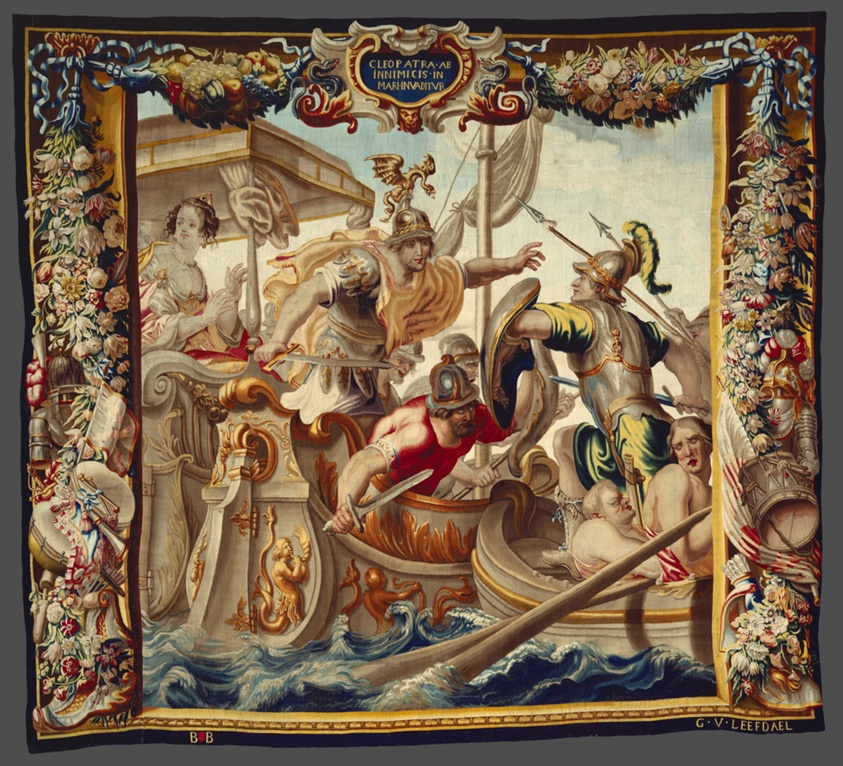
The Battle of Actium from The Story of Caesar and Cleopatra
After a design by Justus van Egmont (1601–1674)LinkedCulture matchlcp-6c2dd7b77fed
- Date
- c. 1680
- Medium
- Wool and silk, slit and double interlocking tapestry weave Warp: Count: 9 warps per cm; wool: S-ply of three Z-spun elements; diameters: 0.5–0.9 mm. Weft: Count: varies from 22 to 37 wefts per cm; wool: S ply of two Z-spun elements; diameters: 0.4–0.8 mm; silk: pairs and three yarns of S-ply of two Z-twisted elements; diameters: 0.6–0.9 mm; wool and silk: paired yarns of S-ply of two Z-spun wool elements and S-ply of two Z-twisted silk elements; diameters: 0.6–1.0 mm
- Culture
- Brussels
- Department
- Textiles
- Institution
- Art Institute of Chicago
- Object ID
- 147056
From the Art Institute of Chicago record
During the winter of 42–41 BCE, Cleopatra became pregnant with twins. The following year, however, Antony returned to Rome and prepared a long-awaited campaign against the Parthians. Yet Octavian failed to support the endeavor. Disappointed, Antony left Italy and sailed to Alexandria, where he renewed his relationship with Cleopatra. Meanwhile, the triumvirate disintegrated, and Octavian rose to power in Rome. Eventually Antony broke off relations with Octavian, and in 31 BCE civil war broke out again. The decisive sea battle was fought at Actium, a promontory in northern Greece. As depicted in the tapestry, the Egyptian fleet was destroyed by the Romans, and Antony fled to Egypt in Cleopatra’s boat. In 30 BCE, Octavian invaded Egypt. Rather than surrender to his enemy, Antony committed suicide. A few days later, Cleopatra followed his example. Their tragic deaths are not included in this suite.
The authoritative record is held by Art Institute of Chicago. LinkedCulture surfaces this object and its connections; it does not alter institutional metadata.
Get printable QR codesHide QR codes
Open QR codes for this object page and the museum record. They stay collapsed until needed.
Provenance & credit
As published by the source institution. Coverage varies — not every institution's open-data feed includes ownership history.
- Credit line
- Gift of Mrs. Chauncey McCormick and Mrs. Richard Ely Danielson
- Provenance
- Possibly the Villalonga family, Mallorca, to 1914 at the latest; Charles Deering (died 1927), Marycel, Sitges, Spain, by 1914; by descent to his daughters Mrs. Chauncey McCormick (born Marion Deering, died 1965) and Mrs. Ely Danielson (born Barbara Deering, died 1982); given to the Art Institute, 1944.
Linked open data
Authority identifiers that link this record into the wider web of cultural data — stable references you can follow to the source.
- Object type
- AAT300014063
Related across collections
Semantically similar works from Art Institute of Chicago and other institutions.