Art Institute of Chicago
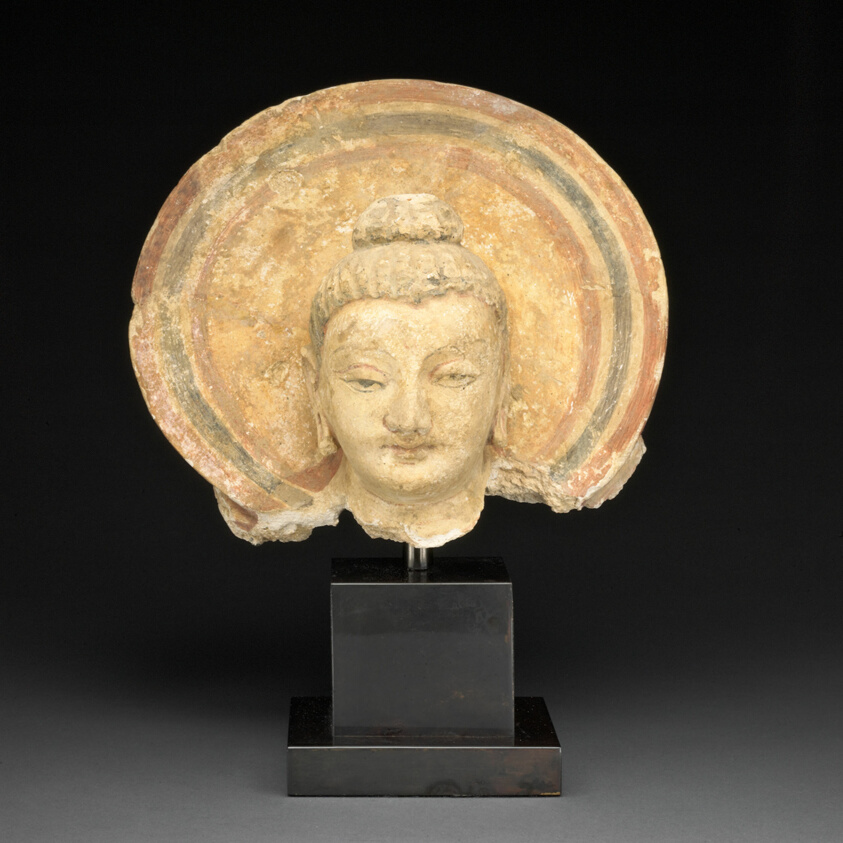
Buddha Head
Afghanistan or PakistanLinkedCulture matchlcp-1de3166917b9
- Date
- 3rd-5th century
- Medium
- Stucco with polychromy
- Culture
- Gandhara
- Department
- Arts of Asia
- Institution
- Art Institute of Chicago
- Object ID
- 153246
From the Art Institute of Chicago record
This excellently preserved head represents key strategies used in the ancient region of Gandhara (present-day Afghanistan and Pakistan) to help worshipers connect with the Buddha (Enlightened One) and his teachings. First, the head is naturalistically modeled and fully colored, and it would have been attached to a robed body, standing or seated in meditation, creating a sense of the Buddha as present and approachable. It also includes a halo, representing the wisdom encoded in Buddhist doctrine, which radiates from the Enlightened One as light. Here the halo is simple, suggesting an early date for this sculpture, but later halos enveloped the entire body and were decorated with sculptural elements such as miniature Bodhisattvas, beings that acted as intermediaries between the Buddha and worshipers. Finally, relics of the historical Buddha (Siddhrtha of the Shakya clan, fl. 5th century BCE), such as bones or jewels, were sometimes embedded in the topknot-covered bump on the head ( ushnisha ) to add another, even more sacred, bodily presence — although this statue does not include relics.
The authoritative record is held by Art Institute of Chicago. LinkedCulture surfaces this object and its connections; it does not alter institutional metadata.
Get printable QR codesHide QR codes
Open QR codes for this object page and the museum record. They stay collapsed until needed.
Provenance & credit
As published by the source institution. Coverage varies — not every institution's open-data feed includes ownership history.
- Credit line
- Gift of Marilynn B. Alsdorf
- Provenance
- Possibly with David M. Lindahl, Kyoto; sold to James W. Alsdorf (1913–1990) and Marilynn B. Alsdorf (1925–2019), Winnetka and Chicago, IL, April 26, 1985 [invoice from Lindahl; copy in curatorial object file]; by descent to Marilynn B. Alsdorf, Chicago, 1990 [on long-term loan at the Art Institute of Chicago, Sept. 17, 1997; publicly promised as a gift to the Art Institute of Chicago, Sept. 24, 1997; signed a promised gift agreement for the work, Sept. 28, 2010]; given to the Art Institute of Chicago, April 14, 2016.
Linked open data
Authority identifiers that link this record into the wider web of cultural data — stable references you can follow to the source.
- Object type
- AAT300301253
Part of a LinkedCulture topic
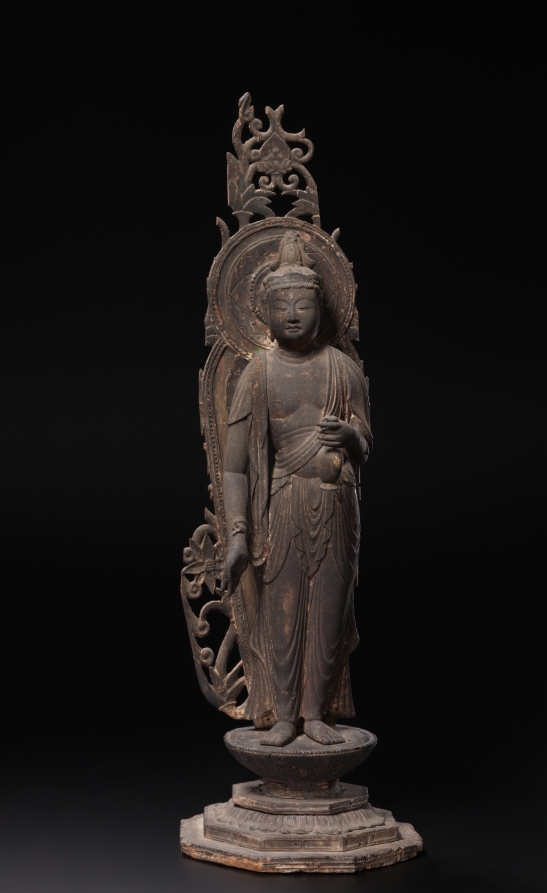 Buddhist and Hindu Iconography
These objects are connected by their representation of sacred figures and deities from Buddhist and Hindu religious traditions across Asian cultures, including sculptures, paintings, and ritual objects depicting buddhas,
183 objects from 5 institutions
Related across collections
Semantically similar works from Art Institute of Chicago and other institutions.