Art Institute of Chicago
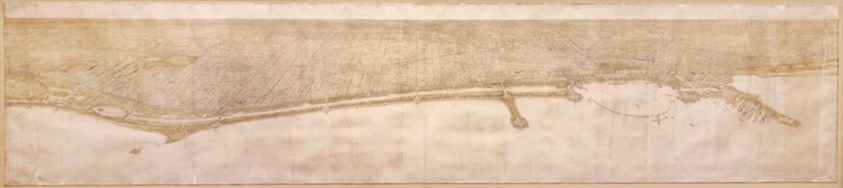
Plate 49 from Plan of Chicago 1909: Chicago. View of the City from Jackson Park to Grant Park, Looking Towards the West. The proposed shore treatment as a park enclosing a waterway (or a series of lagoons) is shown, together with the enlarged yacht harbor, recreation piers, and a scheme for Grant Park.
Daniel Hudson Burnham, American, 1846-1912LinkedCulture matchlcp-f097aed13c5b
- Date
- 1907
- Medium
- Watercolor with graphite on cream wove paper, discolored to tan, laid down on canvas
- Culture
- Chicago
- Department
- Architecture and Design
- Institution
- Art Institute of Chicago
- Object ID
- 196323
From the Art Institute of Chicago record
“Make no little plans,” Daniel H. Burnham reputedly exclaimed around the time he unveiled his Plan of Chicago , the first comprehensive metropolitan plan in the United States. Providing the vocabulary for Chicago architecture through the 1920s, the project was the legacy of Burnham, whose renown in large-scale city planning began when he was chief of construction for Chicago’s 1893 World’s Columbian Exposition. Commissioned by the Commercial Club of Chicago, the plan was developed with the assistance of architect Edward H. Bennett, who elaborated parts of it after Burnham’s death in 1912 and was responsible for executing many of its recommendations. Emulating the grand classical design of European cities, Chicago was to become “a Paris by the Lake.” Features included the development of Chicago’s lakefront and Lake Shore Drive, the construction of Grant Park, and the transformation of Michigan Avenue into a premier commercial boulevard following the completion of the Michigan Avenue bridge. Eleven of the seventeen perspective views were rendered by Burnham’s frequent collaborator, the Beaux-Arts-trained Jules Guérin. The draftsman’s stunning, impressionistic views, with their unusual perspectives and dramatic use of color, bring the Plan of Chicago to life, imbuing it, as Burnham stated about his own aims, with the “magic to stir men’s blood.”
The authoritative record is held by Art Institute of Chicago. LinkedCulture surfaces this object and its connections; it does not alter institutional metadata.
Get printable QR codesHide QR codes
Open QR codes for this object page and the museum record. They stay collapsed until needed.
Provenance & credit
As published by the source institution. Coverage varies — not every institution's open-data feed includes ownership history.
- Credit line
- On permanent loan to The Art Institute of Chicago from the City of Chicago
Linked open data
Authority identifiers that link this record into the wider web of cultural data — stable references you can follow to the source.
- Object type
- AAT300054197
Related across collections
Semantically similar works from Art Institute of Chicago and other institutions.