Art Institute of Chicago
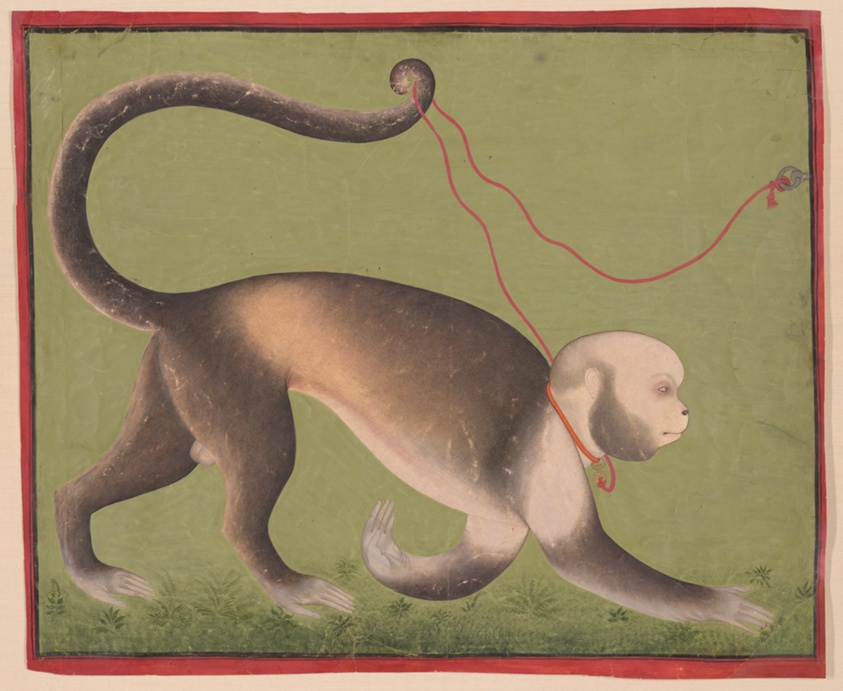
A Monumental Portrait of a Monkey
IndiaLinkedCulture matchlcp-1953a76f7207
- Date
- c. 1705–1710
- Medium
- Opaque watercolor and gold on paper
- Culture
- India
- Department
- Arts of Asia
- Institution
- Art Institute of Chicago
- Object ID
- 210511
From the Art Institute of Chicago record
Except for depictions of the monkey-god Hanuman, monkeys are rarely the subject of portraits in India. In this monumental portrait, therefore, we are looking not only at an unusual subject matter but also at a study of an extraordinary simian: one with human features complete with a beard, pale eyes, and long, slender hands. The inscription on the back of this work, written in Devanagari, states that the monkey is named Husaini and “comes from” Nawab Davad (or Daud) Khan. This name most likely refers to Daud Khan Panni, a powerful nobleman and a faujdar (a military commander and territorial administrator) who served the Mughal emperors from Aurangzeb (r. 1658–1707) through Farrukhsiyar (r. 1713–19), in various parts of India. The painting has been dated to 1705/10 and is attributed to the anonymous artist now called the Stipple Master. Working in tandem with his patron Maharana Amar Singh II of Mewar (r. 1698–1710), this artist was the initiator of a new painting style in Mewar in the late seventeenth and early eighteenth centuries. A group of about forty-six paintings, including the present work, has now been attributed to this artist-patron duo.
The authoritative record is held by Art Institute of Chicago. LinkedCulture surfaces this object and its connections; it does not alter institutional metadata.
Get printable QR codesHide QR codes
Open QR codes for this object page and the museum record. They stay collapsed until needed.
Provenance & credit
As published by the source institution. Coverage varies — not every institution's open-data feed includes ownership history.
- Credit line
- Lacy Armour Fund, James and Marilynn Alsdorf Acquisition Fund
Linked open data
Authority identifiers that link this record into the wider web of cultural data — stable references you can follow to the source.
- Object type
- AAT300033618
Related across collections
Semantically similar works from Art Institute of Chicago and other institutions.