Art Institute of Chicago
Charger
London, EnglandLinkedCulture matchlcp-82080e1c6c43
- Date
- c. 1675
- Medium
- Tin-glazed earthenware
- Culture
- Lambeth
- Department
- Applied Arts of Europe
- Institution
- Art Institute of Chicago
- Object ID
- 22183
From the Art Institute of Chicago record
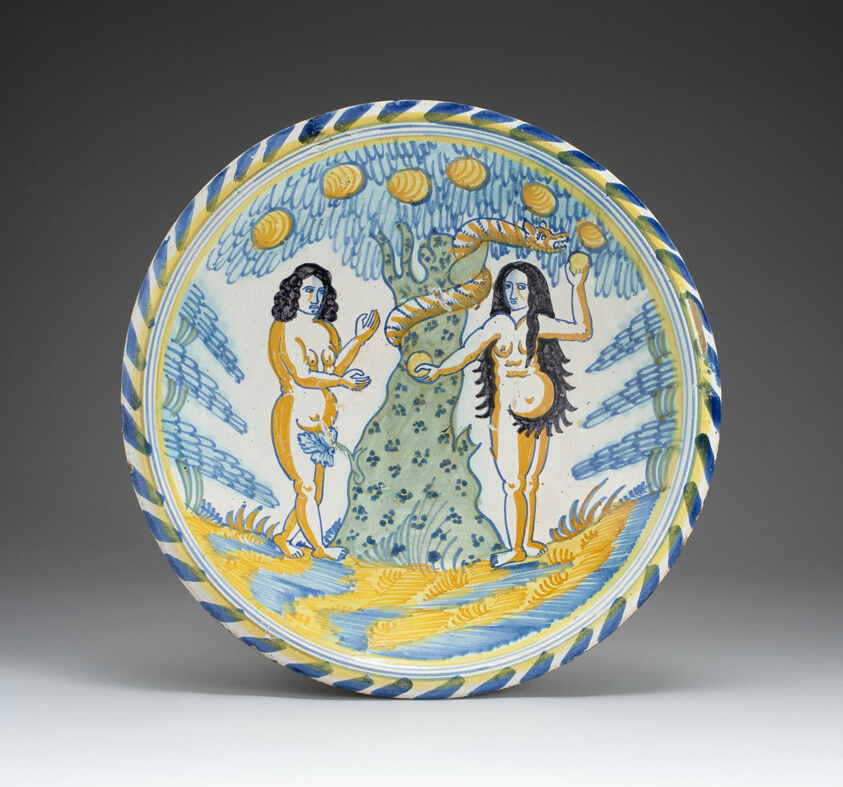
This charger, or large plate, is an example of English delftware, a kind of tin-glazed earthenware made with techniques similar to those used to produce ceramics in the town of Delft in Holland. The scene on the charger shows the serpent compelling Eve to tempt Adam, resulting in their expulsion from the Garden of Eden. Striking visual characteristics of this dish include the speckled trunk of the tree and the fact that both Adam and Eve have similarly rounded bellies and bosoms. The charger’s color scheme, dominated by blues, yellows, and greens on a white background, is typical of English delftware of the period. The serpent, with its striped body and dragon-like face, appears ready to bite the fruit out of Eve’s outstretched left hand. The coloring of the Tree of Knowledge has a kind of storybook charm, with a green trunk and blue foliage and large yellow orbs of fruit, resembling oranges or Asian pears. It is possible that this piece was made for someone associated with the Worshipful Company of Fruiterers, one of the London guilds, whose coat of arms included a representation of Adam and Eve with the forbidden fruit.
The authoritative record is held by Art Institute of Chicago. LinkedCulture surfaces this object and its connections; it does not alter institutional metadata.
Get printable QR codesHide QR codes
Open QR codes for this object page and the museum record. They stay collapsed until needed.
Provenance & credit
As published by the source institution. Coverage varies — not every institution's open-data feed includes ownership history.
- Credit line
- Mary E. Hipple Memorial Fund
Linked open data
Authority identifiers that link this record into the wider web of cultural data — stable references you can follow to the source.
- Object type
- AAT300386308
Related across collections
Semantically similar works from Art Institute of Chicago and other institutions.