Art Institute of Chicago
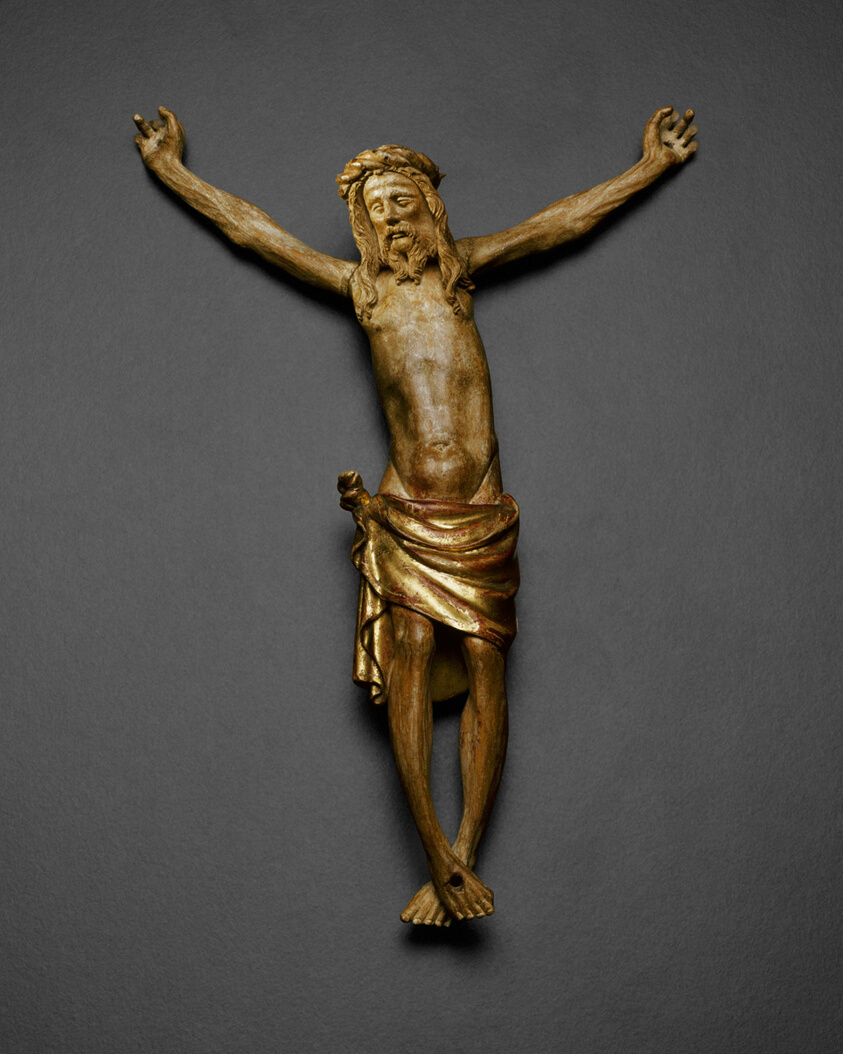
Corpus of Christ, from the Altarpiece of the Crucifixion
Jacques de Baerze (Netherlandish, active before 1384–1399)LinkedCulture matchlcp-098a6d1358ed
- Date
- 1391–99
- Medium
- Wood with gilding and traces of polychromy
- Culture
- Flanders
- Department
- Painting and Sculpture of Europe
- Institution
- Art Institute of Chicago
- Object ID
- 52560
From the Art Institute of Chicago record
Corpus of Christ was originally the focal point of a large triptych combining painting and sculpture that was commissioned in 1390 by Philip the Bold, Duke of Burgundy, for the newly founded Charterhouse of Champol outside Dijon. Philip intended this monastery as a dynastic burial place, and he and his successors endowed it with artistic treasures. The triptych was a collaboration between two important artists from the Flemish territories controlled by Philip the Bold: the sculptor Jacques de Baerze and the painter Melchior Broederlam. When open, the altarpiece showed carved reliefs of the Crucifixion, the Adoration of the Magi, and the Entombment together with standing figures of saints. The gilded center could be covered by movable wings whose backs, painted with scenes from the Infancy of Christ by Broederlam, were visible when the altarpiece was closed. The triptych still survives in Dijon (Musée des Beaux-Arts), but the central figure of the crucified Christ was removed during the French Revolution. Even separated from its context within the altarpiece, however, the crucified Christ remains a powerfully expressive work. Christ’s tensed hands and feet and earthy features are realistically observed, while the curving contour of his torso and the folds of his loincloth reflect a more courtly ideal.
The authoritative record is held by Art Institute of Chicago. LinkedCulture surfaces this object and its connections; it does not alter institutional metadata.
Get printable QR codesHide QR codes
Open QR codes for this object page and the museum record. They stay collapsed until needed.
Provenance & credit
As published by the source institution. Coverage varies — not every institution's open-data feed includes ownership history.
- Credit line
- Gift of Honoré Palmer
- Provenance
- Commissioned by Philip the Bold, Duke of Burgundy, for the Chartreuse de Champmol, Dijon, France, 1390, and installed there on the high altar of the Saint-Jean Chapel by Melchior Broederlam, 1399 [see Müller 1966]; removed to the abbey of Saint-Bénigne, Dijon, 1792 [see Musée de Beaux-Arts de Dijon 1960; Goetz 1950, p. 159; and Cleveland 2004 exh. cat.]; transferred to the Musée de Beaux-Arts de Dijon, 1818/19 [see Goetz 1950, p. 159; Chabeuf 1910, p. 123; Musée de Beaux-Arts de Dijon 1960, which gives the date as 1818; and Cleveland 2004 exh. cat., which gives the date as 1819]. Paul Buffet, Dijon, after 1841 [see Goetz 1950, pp. 159-60; Vitry 1907, pp. 4–5; and Gillerman 2001, p. 22]; given to François Dameron (d. 1900), Dijon, and held in his possession until 1900 [see Goetz 1950, p. 160; Vitry 1907, p. 5; and Chabeuf 1910, p. 122]; by descent to his widow (d. 1906), Dijon [see sources cited above]; sold to a second-hand dealer (“brocanteur”), Dijon, 1906 [see Goetz 1950, p. 160]. Marcel Bing, Paris, by 1907 [see Vitry 1907 and Gillerman 2001, p. 22]; sold to Bertha Honoré Palmer (d. 1918), Chicago, 1910 [see letter from Marcel Bing to Bertha Honoré Palmer, 13 May 1910, in curatorial file]; by descent to her son, Honoré Palmer, Chicago; given to the Art Institute, 1944.
Linked open data
Authority identifiers that link this record into the wider web of cultural data — stable references you can follow to the source.
- Object type
- AAT300301253
Related across collections
Semantically similar works from Art Institute of Chicago and other institutions.