Art Institute of Chicago
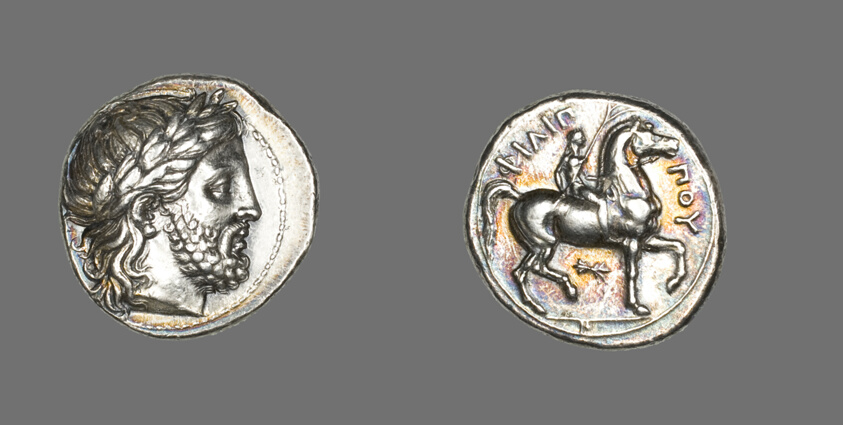
Tetradrachm (Coin) Depicting the God Zeus
Greek; minted in Pella, ancient Macedon, GreeceLinkedCulture matchlcp-bfb5c91dae65
- Date
- Reign of Phillip II (359–336 BCE)
- Medium
- Silver
- Culture
- Pella
- Department
- Arts of Greece, Rome, and Byzantium
- Institution
- Art Institute of Chicago
- Object ID
- 5761
From the Art Institute of Chicago record
The official record of quadrennial games honoring the supreme Greek god Zeus at a sanctuary dedicated to him at Olympia began in 776 BCE. With few interruptions, they took place every four years for about 1,100 years. In 394, CE the Christian emperor Theodosius I (reigned 379–95) abolished them as pagan rites. The most prestigious competition remained the footrace, but eventually it was supplanted in popularity by the horse races. Horses were symbols of socioeconomic status, since only the privileged could afford to buy, feed, and train them and transport their teams and trainers to Olympia every four years. In time, many of the victors in the horse races included kings and tyrants. Philip II, king of Macedon, who minted this coin, owned the horse that won the race in Olympia in 356 BCE. The same year his son was born; he would grow up to become Alexander the Great (356–332 BCE). The head of Zeus on the front referred to Philip's claim that his family descended from the god. On the back Philip commemorated his victory in the horse races of the Olympic Games with an image of a jockey astride his mount.
The authoritative record is held by Art Institute of Chicago. LinkedCulture surfaces this object and its connections; it does not alter institutional metadata.
Get printable QR codesHide QR codes
Open QR codes for this object page and the museum record. They stay collapsed until needed.
Provenance & credit
As published by the source institution. Coverage varies — not every institution's open-data feed includes ownership history.
- Credit line
- Gift of Martin A. Ryerson
- Provenance
- Martin A. Ryerson (1856-1932), Chicago; given to the Art Institute of Chicago, 1922.
Linked open data
Authority identifiers that link this record into the wider web of cultural data — stable references you can follow to the source.
- Object type
- AAT300037334
Part of a LinkedCulture topic
 Ancient Greek Silver Tetradrachms
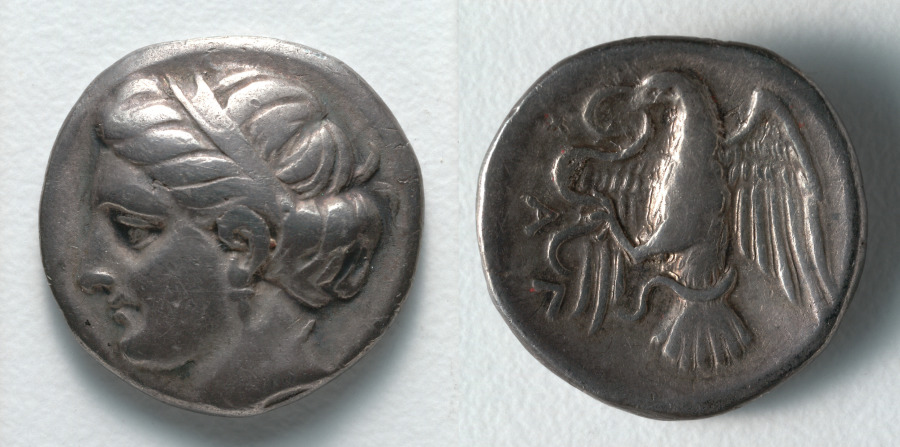
These objects are all tetradrachm coins, a standard ancient Greek silver denomination, depicting various deities and symbols from Greek city-states and territories across the Mediterranean.
333 objects from 3 institutions
Related across collections
Semantically similar works from Art Institute of Chicago and other institutions.