Art Institute of Chicago
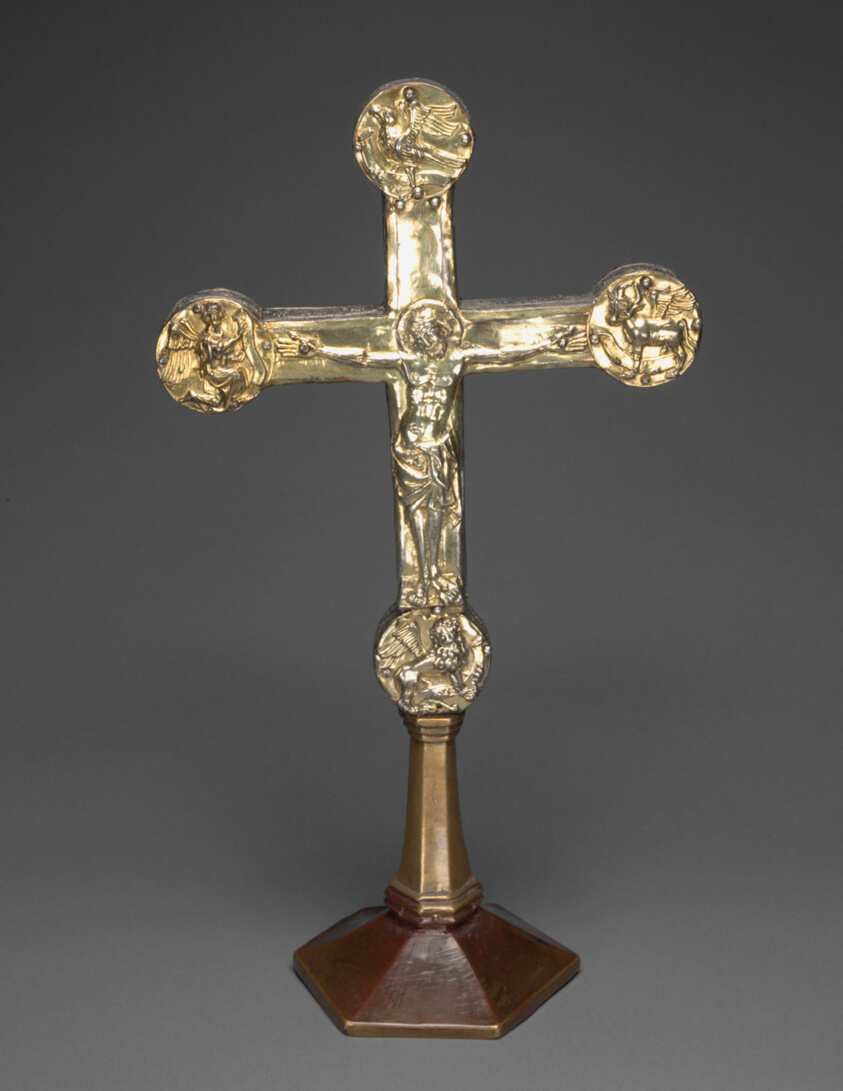
Altar Cross
German, probably Brunswick (Braunschweig)LinkedCulture matchlcp-1df7f105a07b
- Date
- c. 1325; foot: 15th century
- Medium
- Silver gilt over a wooden core; foot: copper gilt
- Culture
- Brunswick
- Department
- Applied Arts of Europe
- Institution
- Art Institute of Chicago
- Object ID
- 8254
From the Art Institute of Chicago record
This silver-gilt cross with the figure of the crucified Christ was meant to be placed on an altar. Each arm of the cross terminates with a roundel containing the symbols of the four Evangelists: the angel for Saint Matthew, the lion for Saint Mark, the ox for Saint Luke, and the eagle for Saint John the Evangelist. These four images were cast from the same molds used for the Evangelist symbols that decorate a silver book cover made for a liturgical manuscript written in 1326, now housed in the Kunstgewerbemuseum in Berlin. This reuse of molds provides valuable insight into workshop practices under the patronage of Otto the Mild, Duke of Saxony (r. 1318–46).
The authoritative record is held by Art Institute of Chicago. LinkedCulture surfaces this object and its connections; it does not alter institutional metadata.
Get printable QR codesHide QR codes
Open QR codes for this object page and the museum record. They stay collapsed until needed.
Provenance & credit
As published by the source institution. Coverage varies — not every institution's open-data feed includes ownership history.
- Credit line
- Gift of the Antiquarian Society
- Provenance
- Presumably made for the collegiate church of Saint Blaise, Braunschweig though it does not appear in the 1482 inventory of the relic treasure since it is not a reliquary; Saint Blaise being under the direct patronage of the dukes of Braunschweig-Lüneburg, 1931.263 was apparently given, with bulk of the church’s relic treasure to Duke Johann Friedrich (died 1679) in 1671 as part of a settlement among members of the ducal family [see Jaitner 1986 [1987], pp. 391-92]; it is first documented in this collection in Molanus 1697, no. 30 (Ein kupffern vergüldetes Crucifix ohne Reliquien); by descent in the Hannover branch of the ducal family of Braunschweig-Lüneburg and preserved with the rest of the treasure in the court chapel of the Leineschloss, Hannover; temporarily removed for safe-keeping during the Seven Years War ( from 1757-64) and the Napoleonic Wars (removed 1803-1816) [Jaitner 1986 [1987], p. 393]; in 1862 installed in the Welfenmuseum in the Altenburg-Palais, Hannover, founded by King George V of Hannover (died 1878) [Hannover became a kingdom at the Congress of Vienna 1814/15; for the foundation of the museum, whose name evoked the medieval glory of the Welf or Guelph dynasty, see Jaitner 1986 [1987], pp. 393-98 and de Winter 1985, p. 13]; in 1867, following the annexation of the kingdom of Hannover by Prussia, moved with the bulk of the treasure to the exiled former king’s villa in Hietzing near Vienna; deposited at the Österreichisches Museum für Kunst und Industrie, Vienna, 1869 to 1906 [Jaitner 1986 [1987], pp. 402, 420 n. 59–the former king was styled duke of Cumberland];1906 sent to the duke of Cumberland’s palace in Penzing on the outskirts of Vienna and in 1920 to Schloss Cumberland in Gmunden, Austria [Jaitner 1986 [1987], p. 404]; in November 1927, the treasure was deposited with a bank in Aarau, Switzerland; at the end of 1929 under Ernst August III as head of the house of Hannover, the treasure was sold to a consortium of Frankfurt dealers: Julius Falk Goldschmidt of the firm I. S. Goldscmidt, Zacharias Max Hackenbroch, and Isaak Rosenbaum and Saemy Rosenbaum of the firm J. Rosenbaum [see De Winter 1985, p. 133; Jaitner 1986 (1987), p. 415 gives January 6, 1930 as the conclusion of the transaction]; 1931.263 was purchased by the Antiquarian Society of the Art Institute of Chicago in 1931 and given to the museum (receipt R 4808 dated April 24, 1931 in Registrar’s office).
Linked open data
Authority identifiers that link this record into the wider web of cultural data — stable references you can follow to the source.
- Object type
- AAT300411548
Related across collections
Semantically similar works from Art Institute of Chicago and other institutions.