Cleveland Museum of Art
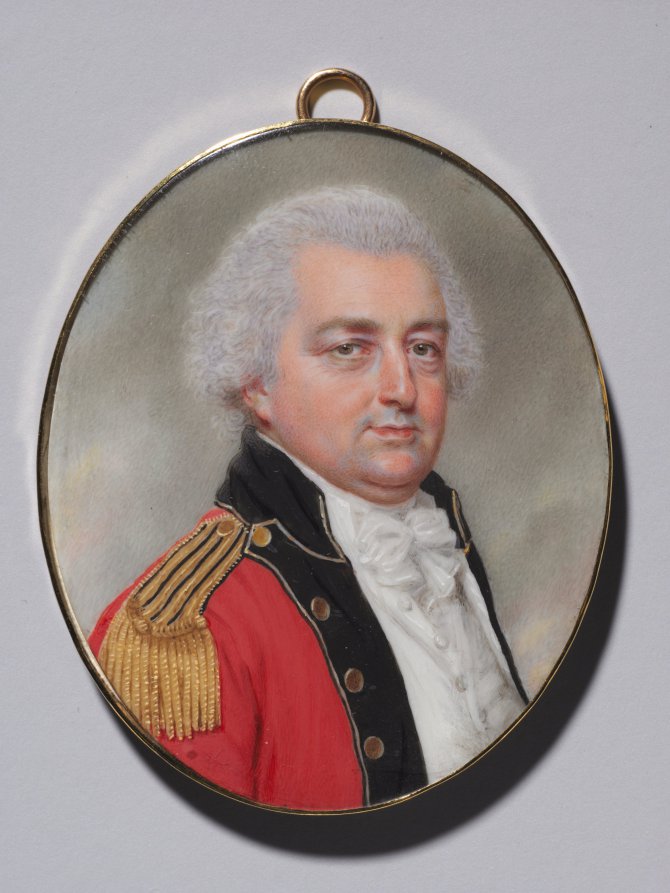
Portrait of an Officer
John I SmartLinkedCulture matchlcp-678a8aa663ce
- Date
- c. 1794
- Medium
- watercolor on ivory in a contemporary gold frame with plain back
- Culture
- England, late 18th century
- Department
- European Painting and Sculpture
- Institution
- Cleveland Museum of Art
- Object ID
- 121287
From the Cleveland Museum of Art record
The unknown sitter has powdered hair, brown eyes, a ruddy complexion, and facial hair stubble. He wears a red military coat with black facings, gold buttons, gold epaulet, a white waistcoat, and frilled cravat. His uniform identifies him as an Indian militia officer, though his precise rank cannot be determined since his left shoulder is not visible. The background is mottled gray. The red of the officer’s coat is also painted in red on the back of the ivory support. Back-painting was a process employed by miniaturists to heighten the brilliancy of certain colors, especially in a sitter’s costume and on the face to enhance bright eyes or pink lips and cheeks. John Smart did not back-paint all of his works, using the technique selectively in portraits in which he wished to achieve a particularly bright color that would show through the back due to the translucency of the thin ivory. The miniature is housed in a contemporary gold frame. This portrait is unsigned and undated, which was an unusual practice for Smart and may be explained by the existence of a variant of this portrait signed and dated “JS / 1794 / I.” Daphne Foskett reproduces the signed work in her 1987 catalogue and refers to the Cleveland miniature as a “replica.” The Cleveland portrait may have been a second version by Smart, who sometimes did not sign even the copies he executed himself. This variant is probably the one referred to by Arthur Jaffé as being formerly in the Warneck collection and sold in Paris on April 11, 1924, by the dealer Leo Schidlof. By 1976 it was in the Asprey collection in London. The miniature was then sold at auction at Christie’s, London, on March 17, 1987 (lot 141) and purchased by David Berkeley, Channel Islands. The sales catalogue identifies the gentleman as an officer of the 5th Madras Native Infantry; however, when Berkeley contacted the National Army Museum in London regarding the identification of the uniform, he was told that this attribution was incorrect, as that regiment had black facing colors only after 1798. The uniform worn by this unknown sitter identifies him as an Indian militia officer.
The authoritative record is held by Cleveland Museum of Art. LinkedCulture surfaces this object and its connections; it does not alter institutional metadata.
Get printable QR codesHide QR codes
Open QR codes for this object page and the museum record. They stay collapsed until needed.
Provenance & credit
As published by the source institution. Coverage varies — not every institution's open-data feed includes ownership history.
- Credit line
- The Edward B. Greene Collection
- Provenance
- -1928: (Leo Schidlof (1886-1966), Paris, France, sold to Edward B. Greene). | 1928-1942: Edward B. Greene (1878-1957), Cleveland, OH, gifted to the Cleveland Museum of Art | 1942-: The Cleveland Museum of Art, Cleveland, OH
Part of a LinkedCulture topic
 English Portrait Miniatures
A collection of portrait miniatures from 17th-18th century England, predominantly featuring watercolor on ivory or graphite and wash techniques, representing the tradition of intimate personal portraiture in miniature fo
221 objects from 4 institutions
Related across collections
Semantically similar works from Cleveland Museum of Art and other institutions.