Cleveland Museum of Art
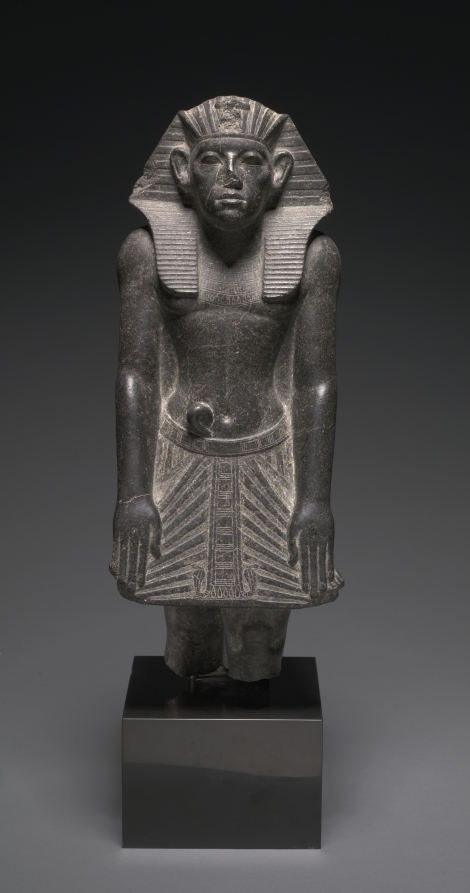
Statue of Amenemhat III
- Date
- c. 1859–1814 BCE
- Medium
- granodiorite
- Culture
- Egypt, Middle Kingdom (2040–1648 BCE), Dynasty 12, reign of Amenemhat III (1860–1814 BCE)
- Department
- Egyptian and Ancient Near Eastern Art
- Institution
- Cleveland Museum of Art
- Object ID
- 136482
From the Cleveland Museum of Art record
Even though this statue of a king is uninscribed, its distinctive features identify it without any doubt as a portrait of Amenemhat III. The heavy brows, prominent cheekbones, hollow cheeks, jutting lower jaw, and tightly bunched muscles at the corners of the mouth make a strikingly realistic impression. Not realistic, however, are the king’s supersized ears. Instead, they symbolize the ruler’s willingness to hear the prayers of his people. If this image had been carved in relief, the king’s hands would have been uplifted in worship. Here, however, to prevent the breakage of projecting limbs, the ruler’s hands are pressed flat against the front his kilt, a portion of which is looped over his belt. The first pyramid Amenemhat III attempted to build, the so-called Black Pyramid, had major construction flaws and had to be abandoned when it started to collapse.
The authoritative record is held by Cleveland Museum of Art. LinkedCulture surfaces this object and its connections; it does not alter institutional metadata.
Get printable QR codesHide QR codes
Open QR codes for this object page and the museum record. They stay collapsed until needed.
Provenance & credit
As published by the source institution. Coverage varies — not every institution's open-data feed includes ownership history.
- Credit line
- Purchase from the J. H. Wade Fund
- Provenance
- -1960: Mrs. Paul Mallon, Paris, France, Sold to the Cleveland Museum of Art | 1960-: The Cleveland Museum of Art, Cleveland, Oh
Part of a LinkedCulture topic
 Ancient Egyptian Personal Objects
These objects are cosmetic implements and grooming tools from ancient Egypt, including mirrors, palettes for grinding pigments, and decorative knives, representing daily life and personal adornment practices.
476 objects from 5 institutions
Related across collections
Semantically similar works from Cleveland Museum of Art and other institutions.