Cleveland Museum of Art
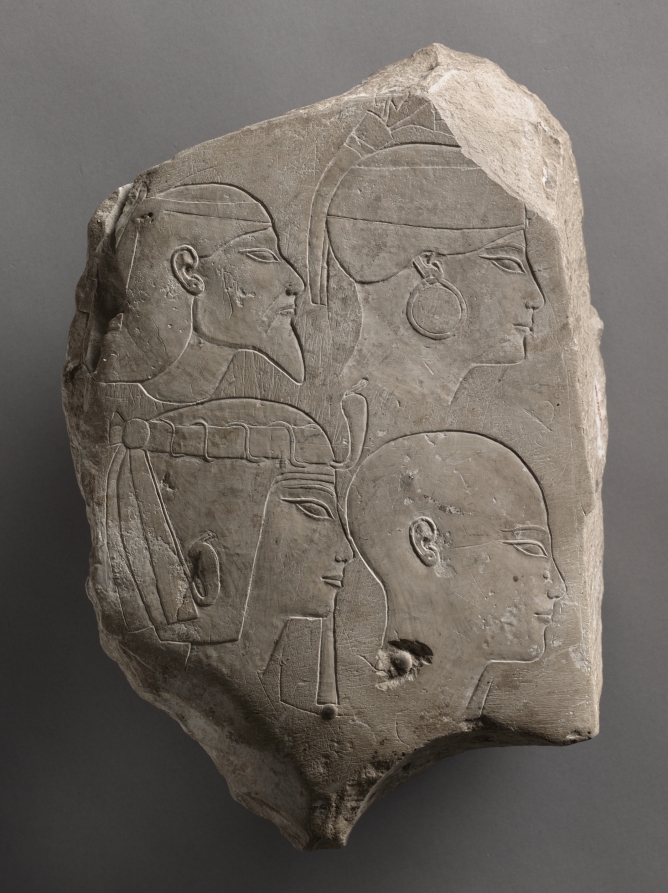
Trial Piece Worked on Both Sides
- Date
- c. 1391–1353 BCE
- Medium
- limestone
- Culture
- Egypt, probably Thebes, New Kingdom (1540–1069 BCE), Dynasty 18, reign of Amenhotep III (1390–1352 BCE)
- Department
- Egyptian and Ancient Near Eastern Art
- Institution
- Cleveland Museum of Art
- Object ID
- 101360
From the Cleveland Museum of Art record
This carved flake of limestone provides a fascinating glimpse of the ancient artist at work. One side, by far the better, features four studies of heads. At the upper left is an Asiatic. He has a low forehead, a prominent nose, and a long, pointed beard. To his right is a Nubian wearing the short, round headdress and large loop earring that the Egyptians usually identified with this ethnic group. The bottom row presents images from within Egypt. At the left is a stock image of a king. To his right is another Egyptian, whose clean-shaven head immediately identifies him as a priest. The rather routine, basic subjects of the other side show a far lower level of accomplishment. The sole details of any skill are the incomplete head of the god Bes at the bottom center and the human ear at the left edge. The simple neb-signs (baskets) are poorly executed, and the drawing of the hand is embarrassingly bad. At the lower right is a thickly banded human eye. Above that is the fair head of a princess wearing a short wig, wide headband, and thick sidelock. At the upper left are the beginnings (or the remains) of the bewigged head of a courtier, the face mostly obliterated. Trial pieces were a necessity of this busy building period because new styles were continually introduced and rapid training of apprentices was needed.
The authoritative record is held by Cleveland Museum of Art. LinkedCulture surfaces this object and its connections; it does not alter institutional metadata.
Get printable QR codesHide QR codes
Open QR codes for this object page and the museum record. They stay collapsed until needed.
Provenance & credit
As published by the source institution. Coverage varies — not every institution's open-data feed includes ownership history.
- Credit line
- Gift of the John Huntington Art and Polytechnic Trust
- Provenance
- Probably Thebes | ?-1920: Jusef Hasan, Luxor, through Howard Carter, sold to the Cleveland Museum of Art | 1920-: The Cleveland Museum of Art, Cleveland, OH
Part of a LinkedCulture topic
 Ancient Egyptian Personal Objects
These objects are cosmetic implements and grooming tools from ancient Egypt, including mirrors, palettes for grinding pigments, and decorative knives, representing daily life and personal adornment practices.
476 objects from 5 institutions
Related across collections
Semantically similar works from Cleveland Museum of Art and other institutions.