Cleveland Museum of Art
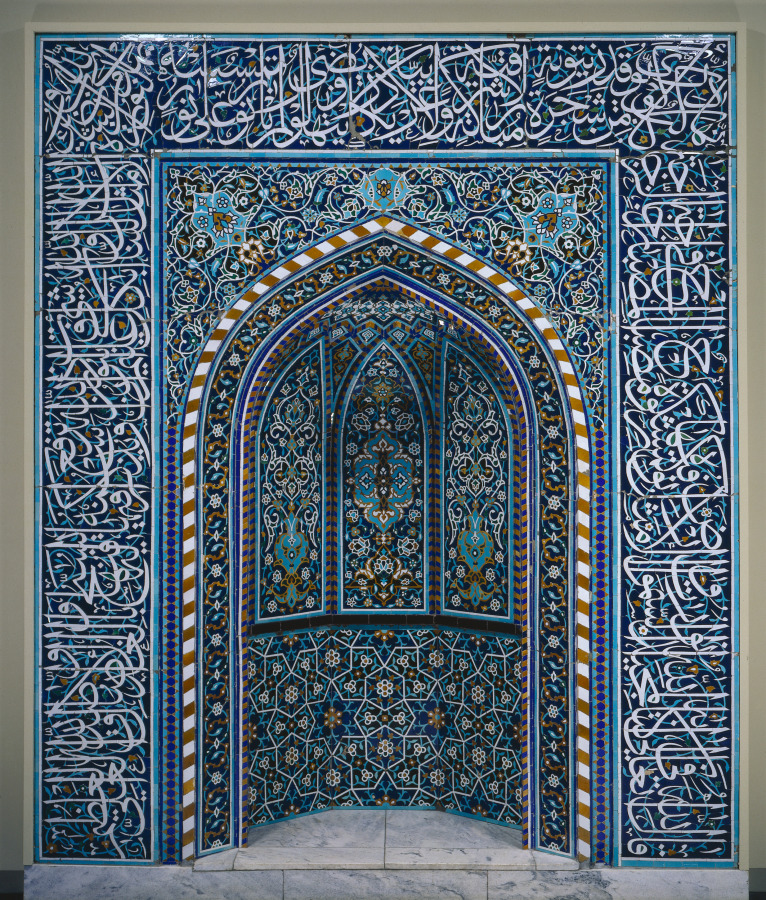
Prayer Niche (Mihrab)
- Date
- c. 1500s or mid-1900s
- Medium
- ceramic mosaic
- Culture
- Iran, Isfahan, in the style of the Safavid period (1501–1722)
- Department
- Islamic Art
- Institution
- Cleveland Museum of Art
- Object ID
- 137298
From the Cleveland Museum of Art record
The prayer niche (or mihrab in Arabic) is the focal point in the interior of a mosque, located in the qibla wall that faces Mecca, the holy city of Islam. Verses from the holy Qur’an, written in a form of Arabic script called thuluth , surround the mihrab. The inscription is rendered with white glaze, while the continuous arabesque vine behind the Qur’anic text is executed in gold, turquoise, and green—the color of the Prophet Muhammad and of paradise. The inscription is from the Chapter of Light ( Surah An-Nur ): “Allah is the light of the Heavens and the Earth. His Light is like a niche in which is a lamp—the lamp enclosed in glass—the glass, as it were, a glistening star; lit from a blessed olive tree, neither of the East nor of the West, whose oil would almost glow, even though fire touched it not. Light upon light! Allah guides whom He will to His light, and Allah sets forth parables for men, and Allah knows all things.” The artistic and calligraphic styles suggest this mihrab was made about 1500, but the physical appearance of the ceramic mosaic pieces does not. The glaze colors are too consistent, and they have not discolored from moisture seeping behind the cut tile edges. Clay substrates of the tiles were tested in 2001 using thermoluminescence to determine the date the tiles were fired. The results indicated that the tiles were modern, made between 1941 and 1961, and they are under further examination. Every mihrab is oriented toward Mecca.
The authoritative record is held by Cleveland Museum of Art. LinkedCulture surfaces this object and its connections; it does not alter institutional metadata.
Get printable QR codesHide QR codes
Open QR codes for this object page and the museum record. They stay collapsed until needed.
Provenance & credit
As published by the source institution. Coverage varies — not every institution's open-data feed includes ownership history.
- Credit line
- Gift of Katharine Holden Thayer
- Provenance
- ?–1962: (Khalil Rabenou [1902–1961], New York, NY, sold to the Cleveland Museum of Art, and purchased with funds from Katharine Holden Thayer [1898–1985]) | 1962–: The Cleveland Museum of Art, Cleveland, OH
Part of a LinkedCulture topic
 Islamic Architectural Ceramics
These objects are all ceramic tiles and architectural elements from Islamic cultures across the Middle East, Central Asia, and North Africa, featuring techniques like fritware, luster painting, and underglaze decoration
60 objects from 5 institutions
Related across collections
Semantically similar works from Cleveland Museum of Art and other institutions.