Cleveland Museum of Art
Qur'an Manuscript Folio
- Date
- 800s
- Medium
- gold, ink and colors on parchment
- Culture
- North Africa, Aghlabid or Abbasid, 9th century
- Department
- Islamic Art
- Institution
- Cleveland Museum of Art
- Object ID
- 157140
From the Cleveland Museum of Art record
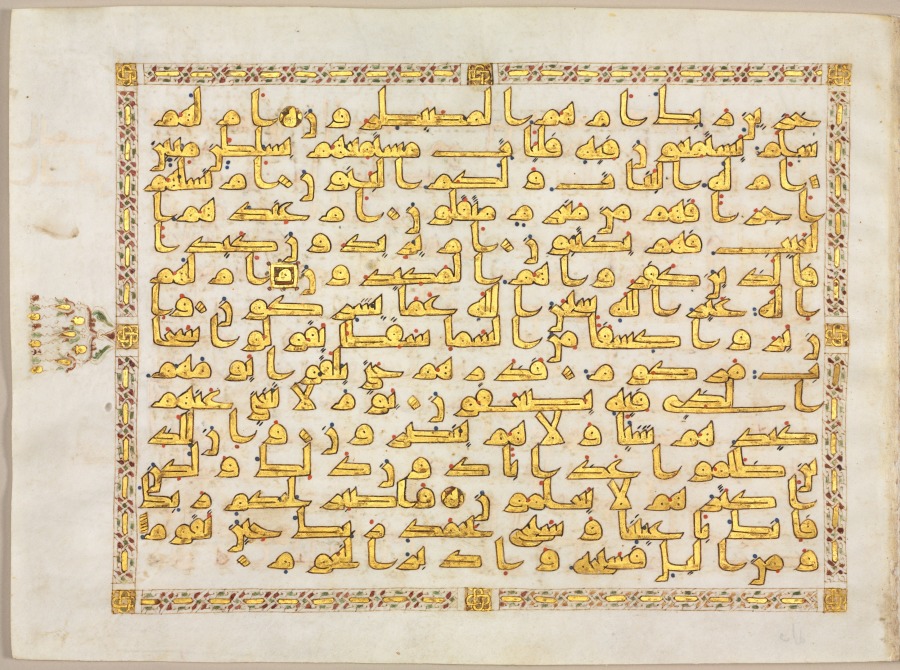
Calligraphy, the art of beautiful writing, was elevated above all other art forms in the Islamic world because Allah, God, revealed the divine word of Islam to the Prophet Muhammad in the Arabic language. Arabic script evolved gradually until the 800s when Muslim scribes produced copies of the Qur'an that were calligraphic masterpieces. This Qur'an, written entirely in gold, exemplifies the angular form of writing known as kufic at its majestic best. Distinctive markings—short ink strokes, colored dots—identify the vocalization of the text. Each folio is framed by an interlacing border and displays a leafy motif in the outer margin. The text on the right page is the opening of the Chapter of the Star (53:1–21) with a section heading in the margin and an illuminated foliate band for the chapter heading at the top of the page. It begins: “By the star when it plunges, your comrade is not astray, neither errs, nor speaks he out of caprice. This is naught but a revelation revealed, taught him by one terrible in power, very strong.” The text on the left page is from the Chapter of the Moon (54:13–27).
The authoritative record is held by Cleveland Museum of Art. LinkedCulture surfaces this object and its connections; it does not alter institutional metadata.
Get printable QR codesHide QR codes
Open QR codes for this object page and the museum record. They stay collapsed until needed.
Provenance & credit
As published by the source institution. Coverage varies — not every institution's open-data feed includes ownership history.
- Credit line
- The Severance and Greta Millikin Purchase Fund
- Provenance
- ?-1993: (Oliver Hoare Limited, London, UK, sold to the Cleveland Museum of Art) | 1993-: The Cleveland Museum of Art, Cleveland, OH
Related across collections
Semantically similar works from Cleveland Museum of Art and other institutions.