Cleveland Museum of Art
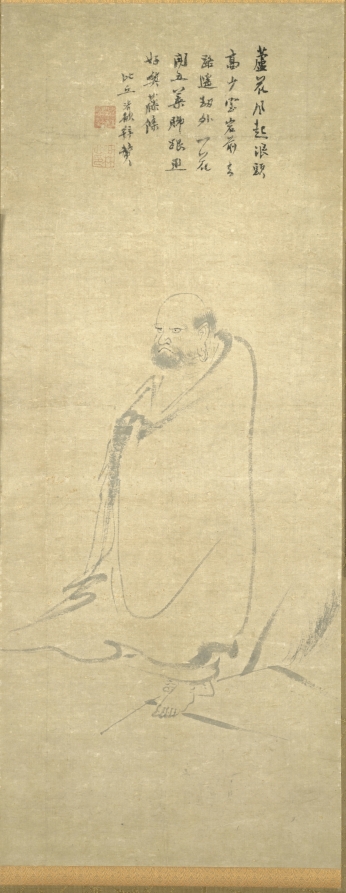
Bodhidharma Crossing the Yangzi on a Reed
- Date
- 1300s
- Medium
- hanging scroll; ink on paper
- Culture
- China, Yuan dynasty (1271-1368)
- Department
- Chinese Art
- Institution
- Cleveland Museum of Art
- Object ID
- 141200
From the Cleveland Museum of Art record
Chan Buddhism was introduced to China in the early 500s by the Indian monk Bodhidharma, or Puti Damo (died before 534). Upon his arrival in China, Bodhidharma was allegedly granted an audience with the Liang dynasty emperor Wu (reigned 502–49). Realizing the emperor did not understand his mission, the monk left Nanjing, crossed the Yangzi on a reed, and settled north in Henan province’s Shaolin monastery. Here, Bodhidharma is sketched in few pale brushstrokes. The diluted and swift lines on an empty ground emphasize the Chan idea that all things are illusionary. The inscription reads: Wind rises from the reed flowers, the waves are high; It’s a long way to go beyond the cliff of the Shaoshi mountain; Above the worlds of kalpas a flower is opening into five petals; So that your barefoot heels are just fine for the whipping rattans. —translated by Wai-Kam Ho Barefooted Bodhidharma sails across the Yangzi River balanced on a thin stalk of reed.
The authoritative record is held by Cleveland Museum of Art. LinkedCulture surfaces this object and its connections; it does not alter institutional metadata.
Get printable QR codesHide QR codes
Open QR codes for this object page and the museum record. They stay collapsed until needed.
Provenance & credit
As published by the source institution. Coverage varies — not every institution's open-data feed includes ownership history.
- Credit line
- John L. Severance Fund
- Provenance
- Okazaki Masaya 岡崎正也 [late 1800s-early 1900s], Tokyo, Japan | Yamamoto Yoshiaki 山本義章 [early 1900s], Tokyo, Japan | Fujī Noriyoshi 藤井德義 [1900s], Osaka, Japan | ?-1964: (N. V. Hammer, Inc., New York, NY, sold to the Cleveland Museum of Art) | 1964-: The Cleveland Museum of Art, Cleveland, OH
Related across collections
Semantically similar works from Cleveland Museum of Art and other institutions.