Cleveland Museum of Art
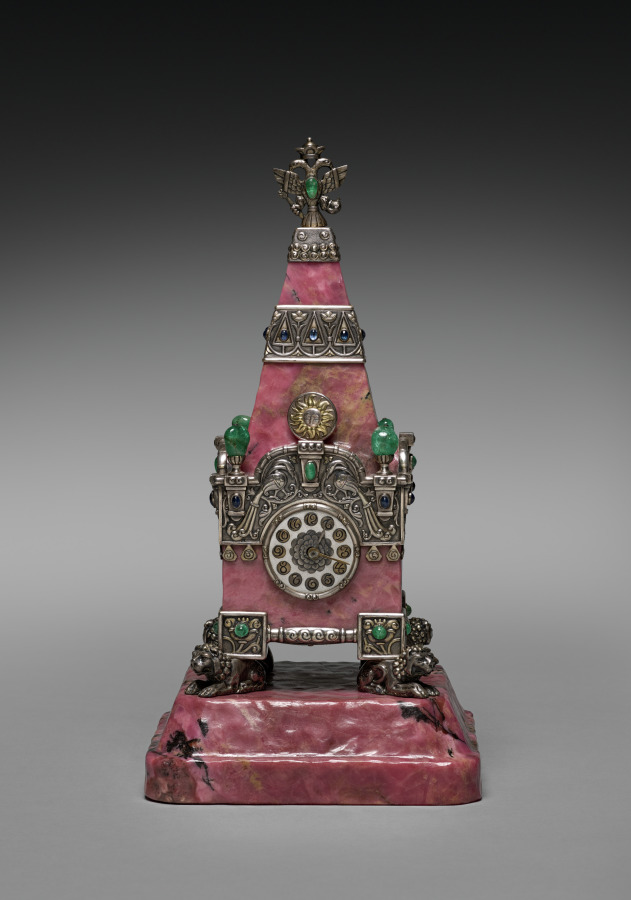
Kremlin Tower Clock
House of FabergéLinkedCulture matchlcp-f2cad58269e3
- Date
- c. 1913
- Medium
- rhodonite, silver, enamel, emeralds, sapphires
- Culture
- Russia, St. Petersburg
- Department
- Decorative Art and Design
- Institution
- Cleveland Museum of Art
- Object ID
- 142773
What the image shows
A decorative clock with a pink base and silver accents.
Generated by LinkedCulture from the photograph alone, without the museum’s catalogue text (Qwen/Qwen2.5-VL-7B-Instruct), and not yet reviewed by a person. It describes the picture, not the object’s history, and it is not part of the museum’s record.
From the Cleveland Museum of Art record
The use of Russian hardstones in creating precious objects became a hallmark of design from the House of Fabergé. Easily carved, these minerals were sourced largely from the western region surrounding the Ural Mountains. Fabergé's workmasters used colorful stones such as agate, nephrite (jade), lapis lazuli, rock crystal, and rhodonite, seen here in this elaborate table or mantel clock, to create all manner of luxurious accessories. Bright pink rhodonite was among the rarest, and consequently most expensive, specimens used by the House of Fabergé. This clock resembles the Taynitskaya Tower, the middle tower on the south side of the Kremlin. The House of Fabergé created this work to commemorate the 300th anniversary of the Romanov dynasty, representing Fabergé's ability to balance the functionality of objects with intricate decorative design. The Kremlin tower, which this clock resembles, has a secret well and an underground tunnel that leads to the Moscow River.
The authoritative record is held by Cleveland Museum of Art. LinkedCulture surfaces this object and its connections; it does not alter institutional metadata.
Get printable QR codesHide QR codes
Open QR codes for this object page and the museum record. They stay collapsed until needed.
Provenance & credit
As published by the source institution. Coverage varies — not every institution's open-data feed includes ownership history.
- Credit line
- The India Early Minshall Collection
- Provenance
- ?-1966: India Early Minshall [1885–1965], Cleveland, OH, bequest to the Cleveland Museum of Art | 1966-: The Cleveland Museum of Art
Related across collections
Semantically similar works from Cleveland Museum of Art and other institutions.