Cleveland Museum of Art
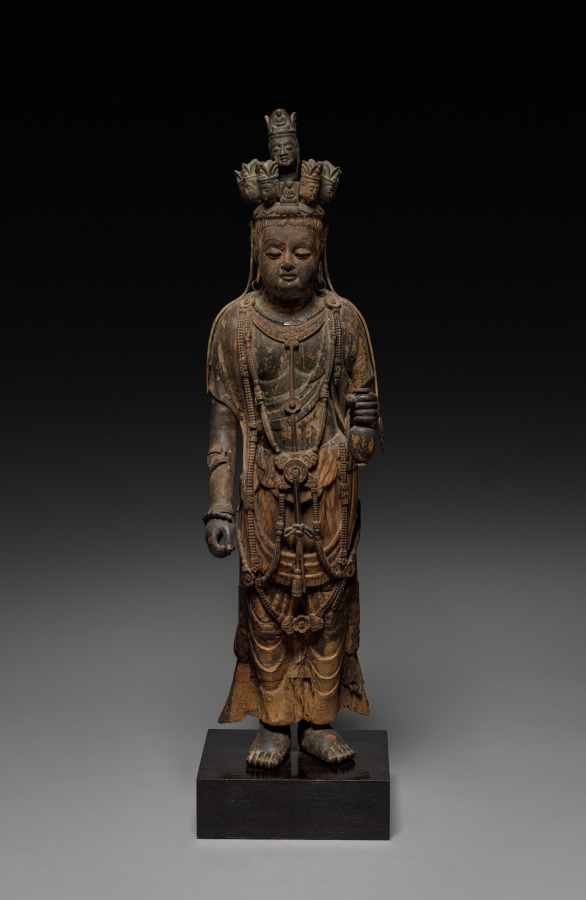
Eleven-Headed Guanyin
- Date
- late 600s
- Medium
- wood
- Culture
- China, Tang dynasty (618–907)
- Department
- Chinese Art
- Institution
- Cleveland Museum of Art
- Object ID
- 145411
From the Cleveland Museum of Art record
Guanyin, the bodhisattva of infinite compassion, can be identified by his attributes, carrying a tiny Amida Buddha in his crown, and holding a bottle with the nectar of life in his left hand. The eleven-headed Guanyin, in particular, has his eyes and ears open in all directions to hear, see, and help all those who are in distress. The garment and jewelry of this graceful figure remind us that the historic Buddha Shakyamuni was originally an Indian prince before he reached enlightenment. Upon his death, he entered nirvana, an eternal state free of desire and suffering, outside the realm of birth, death, and rebirth. The dating and attribution of the figure as being from China needs further study. The sculpture was made of different types of wood with different grain sizes and patterns, which are connected with wood pegs and glue.
The authoritative record is held by Cleveland Museum of Art. LinkedCulture surfaces this object and its connections; it does not alter institutional metadata.
Get printable QR codesHide QR codes
Open QR codes for this object page and the museum record. They stay collapsed until needed.
Provenance & credit
As published by the source institution. Coverage varies — not every institution's open-data feed includes ownership history.
- Credit line
- John L. Severance Fund
- Provenance
- ?-1970: (Mayuyama and Company, Tokyo, Japan, sold to the Cleveland Museum of Art) | 1970-: The Cleveland Museum of Art, Cleveland, OH
Related across collections
Semantically similar works from Cleveland Museum of Art and other institutions.