Cleveland Museum of Art
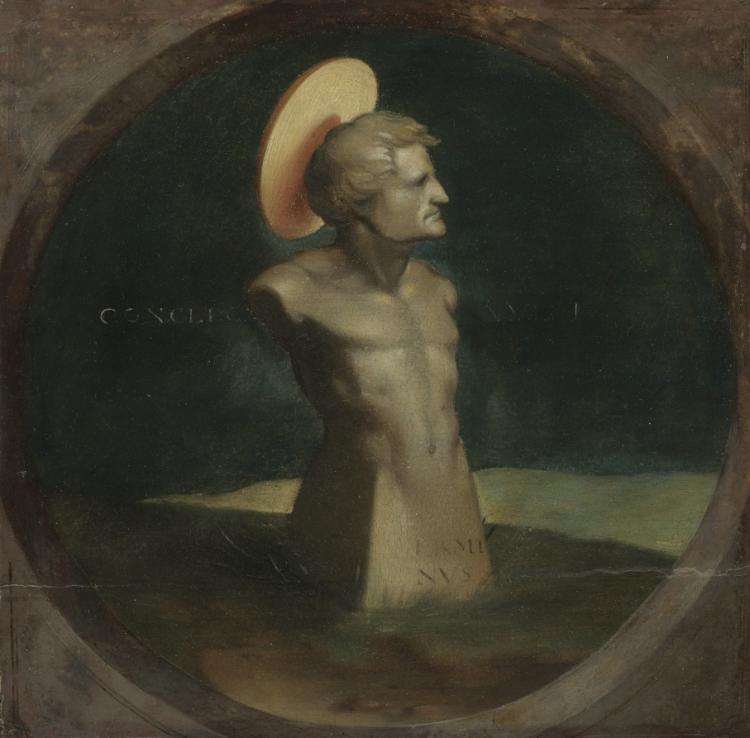
Terminus, the Device of Erasmus
Hans Holbein the YoungerLinkedCulture matchlcp-7fbf92db9cbe
- Date
- c. 1532
- Medium
- oil on wood
- Culture
- Germany
- Department
- European Painting and Sculpture
- Institution
- Cleveland Museum of Art
- Object ID
- 145960
What the image shows
A statue of a nude man with a halo stands in a circular frame against a dark background.
Generated by LinkedCulture from the photograph alone, without the museum’s catalogue text (Qwen/Qwen2.5-VL-7B-Instruct), and not yet reviewed by a person. It describes the picture, not the object’s history, and it is not part of the museum’s record.
From the Cleveland Museum of Art record
In the spirit of the Italian Renaissance, Erasmus of Rotterdam (c. 1466–1536), the celebrated Dutch humanist and scholar, embraced ancient Greek and Roman literature and incorporated much of its moral and ethical messages into his own work. Holbein here conflates Erasmus’s features with Terminus, the Roman god of boundaries, who defied Jupiter by maintaining his position atop Capitoline Hill. Erasmus adopted Terminus, along with the motto concedo nulli (I concede to no one), as a personal symbol for devotion and steadfastness. Tree ring analysis helped determine the date of this painting.
The authoritative record is held by Cleveland Museum of Art. LinkedCulture surfaces this object and its connections; it does not alter institutional metadata.
Get printable QR codesHide QR codes
Open QR codes for this object page and the museum record. They stay collapsed until needed.
Provenance & credit
As published by the source institution. Coverage varies — not every institution's open-data feed includes ownership history.
- Credit line
- Gift of Dr. and Mrs. Sherman E. Lee in memory of Milton S. Fox
- Provenance
- Charlotte Frank (London, England) | -1971: Dr. and Mrs. Sherman Lee, by gift to the Cleveland Museum of Art, 1971. | 1971-: The Cleveland Museum of Art, Cleveland, OH
Related across collections
Semantically similar works from Cleveland Museum of Art and other institutions.