Cleveland Museum of Art
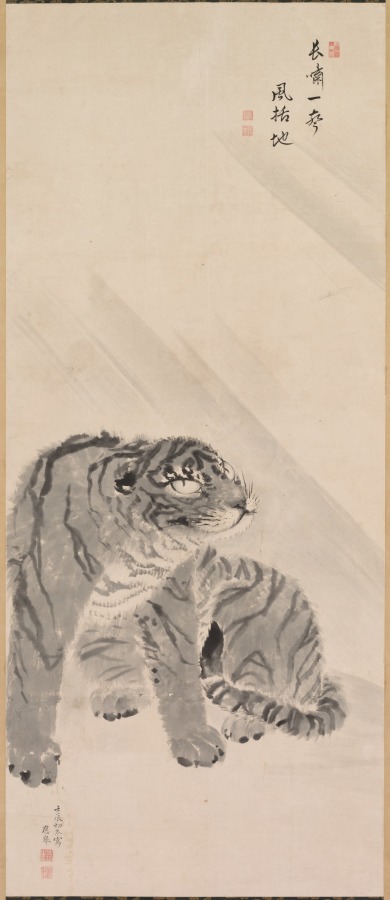
Tiger in Wind
Maruyama ŌkyoLinkedCulture matchlcp-26e4eefa7c04
- Date
- 1800s
- Medium
- hanging scroll; ink on paper
- Culture
- Japan, Edo period (1615–1868) to Meiji period (1868–1912)
- Department
- Japanese Art
- Institution
- Cleveland Museum of Art
- Object ID
- 146036
What the image shows
A tiger cub is depicted in a monochromatic ink painting.
Generated by LinkedCulture from the photograph alone, without the museum’s catalogue text (Qwen/Qwen2.5-VL-7B-Instruct), and not yet reviewed by a person. It describes the picture, not the object’s history, and it is not part of the museum’s record.
From the Cleveland Museum of Art record
The seals appended to the inscription on this painting suggest that the text was brushed by Yūjō (1723–1773), an imperial prince who became a Buddhist monk and was abbot of Enman'in at Miidera. The line is from a poem attributed to a Yuan dynasty poet, Yu Ruyu (dates unknown), and describes the sound of a fierce wind lashing the ground. Wind is associated with the roar of the tiger. Yūjō was Maruyama Ōkyo's most important patron as a young artist, and this painting has a signature asserting that Ōkyo created it in 1772, the year before Yūjō's death. While Yūjō produced a preface for a now famous set of handscrolls he commissioned Ōkyo to paint, and a number of Ōkyo's compositions for Enman'in survive, this work would appear to be one imagining their relationship, as opposed to a genuine piece.
The authoritative record is held by Cleveland Museum of Art. LinkedCulture surfaces this object and its connections; it does not alter institutional metadata.
Get printable QR codesHide QR codes
Open QR codes for this object page and the museum record. They stay collapsed until needed.
Provenance & credit
As published by the source institution. Coverage varies — not every institution's open-data feed includes ownership history.
- Credit line
- Sundry Purchase Fund
- Provenance
- Murado Torujiro, Ōtsu, Japan | ?–1971: (Nisaburo Mizutani, Kyoto, Japan, sold to the Cleveland Museum of Art) | 1971–: The Cleveland Museum of Art, Cleveland, OH
Related across collections
Semantically similar works from Cleveland Museum of Art and other institutions.