Cleveland Museum of Art
Album of Precious Works from Famous Early Modern Calligraphers and Painters (Volume 2)
- Date
- late 1700s to mid-1800s
- Medium
- One of a pair of folding albums; ink and light color on silk, or ink on paper
- Culture
- Japan, Edo period (1615–1868)
- Department
- Japanese Art
- Institution
- Cleveland Museum of Art
- Object ID
- 146393
From the Cleveland Museum of Art record
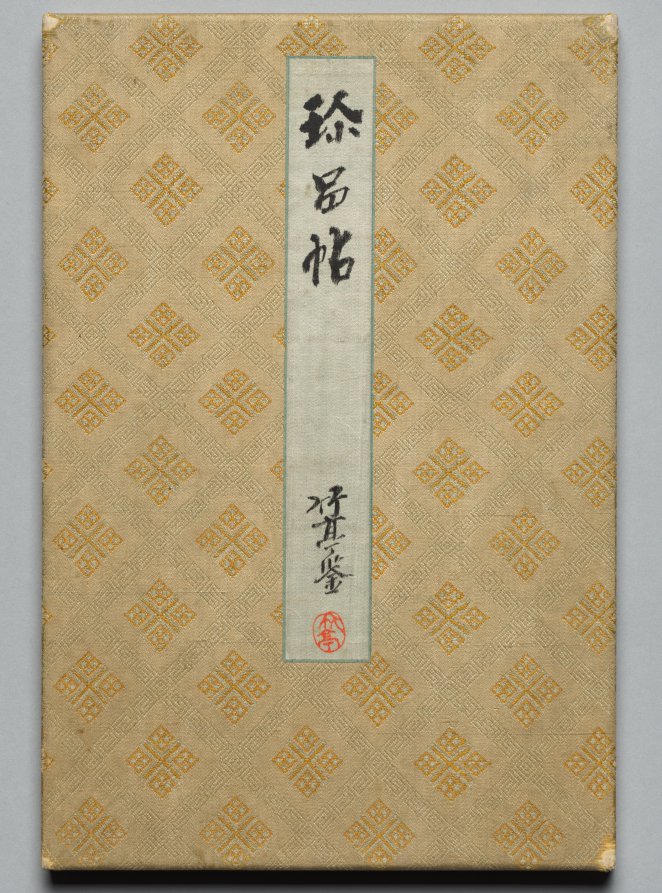
This album begins with a painting of plum and bamboo by Tanomura Chikuden (1777–1835) dated to the first day of 1818. It ends with an undated scene of someone going to visit a friend by Okada Hankō (1782–1845). In between are nine compositions by a variety of artists. There are poems and inscriptions by Rai San'yō (1780–1832) and Rai Shunsui (1746–1816). There are also paintings by Okada Beisanjin (1744–1820), Uragami Gyokudō (1745–1820), Nagamachi Chikuseki (1747–1806), Noro Kaiseki (1747–1828), Aoki Mokubei (1767–1833), and Nukina Kaikoku (1778–1863), who appends a poem to his composition. While most of the paintings are not dated, those that are indicate that the group was painted over a large span of time, rather than on a single occasion. Nagamachi Chikuseki’s figure on a bridge is dated to the 10th lunar month of 1789, while Nukina Kaikoku’s colorful island retreat is from 1833. Aside from the opening composition by Tanomura Chikuden, all the paintings are landscapes following recognizable Chinese brush methods transmitted to Japan through a variety of methods including printed manuals. The calligraphers and painters whose works are represented in the album were all deeply interested in Chinese culture. They were especially attracted to the idea they found in Chinese society of a community of educated friends who shared works in prose, poetry, and painting among one another through correspondence or gatherings. The ideal was a group who were not professional artists, creating works for clients, but a group who produced works to nurture friendships and cultivate their own minds. The cover of the album has a title slip reading Album of Precious Works , and is signed Mirror of the Bamboo Pavilion, or Chikuteikan (竹𠅘鉴 ), with a round, red seal reading Chikutei. This is a pseudonym used most likely by a Japanese person interested in calligraphy composed in Chinese and paintings with Chinese styles and themes. The name evokes a pavilion set in a bamboo grove an image strongly associated with China in Japan. Pseudonyms of this type were and continue to be used by those engaged in cultural pursuits such as poetry composition, painting, and collecting art. Having such a name takes one out of the normal business of life, and transports one to a space of creativity and aesthetic appreciation.
The authoritative record is held by Cleveland Museum of Art. LinkedCulture surfaces this object and its connections; it does not alter institutional metadata.
Get printable QR codesHide QR codes
Open QR codes for this object page and the museum record. They stay collapsed until needed.
Provenance & credit
As published by the source institution. Coverage varies — not every institution's open-data feed includes ownership history.
- Credit line
- Gift of Mary B. Lee, C. Bingham Blossom, Dudley S. Blossom III, Laurel B. Kovacik, and Elizabeth B. Blossom, in memory of Elizabeth B. Blossom
- Provenance
- ?–1972: (Kuniyoshi Miura, Tokyo, Japan, sold to the Cleveland Museum of Art) | 1972–: The Cleveland Museum of Art, Cleveland, OH
Related across collections
Semantically similar works from Cleveland Museum of Art and other institutions.