Cleveland Museum of Art
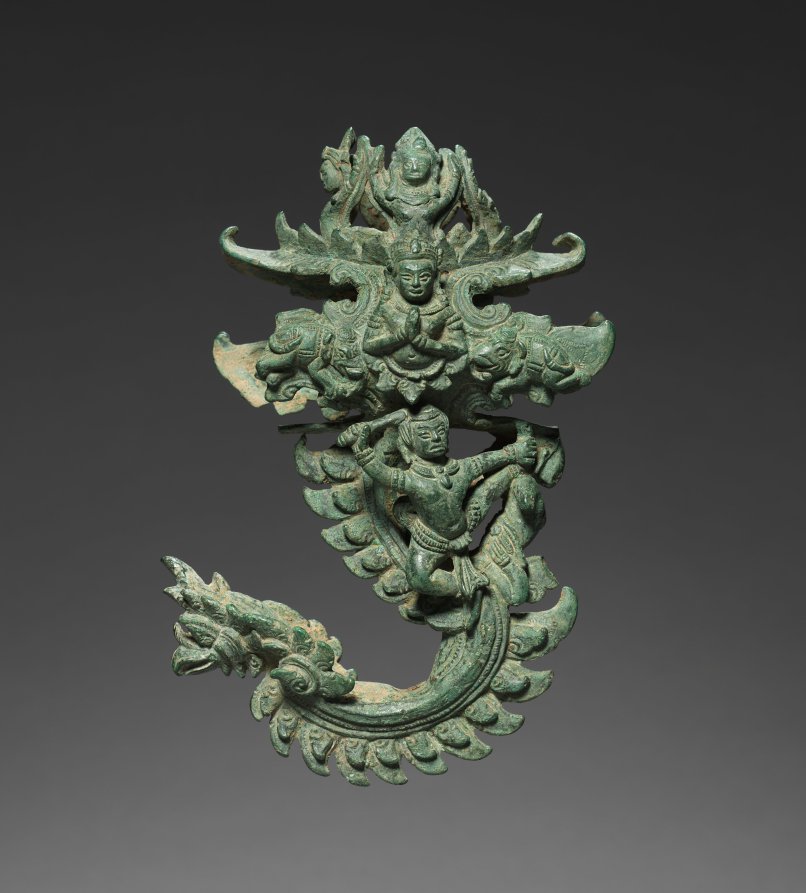
Palanquin Hook
- Date
- 1175–1230
- Medium
- bronze
- Culture
- Cambodia, probably Angkor
- Department
- Indian and Southeast Asian Art
- Institution
- Cleveland Museum of Art
- Object ID
- 150688
From the Cleveland Museum of Art record
When members of the royal family or priesthood traveled in a public festival procession or to a temple to make offerings or participate in a ceremony, they would be carried in a palanquin, or a covered litter. Portable objects of veneration, such as bronze images or a sacred fire, were also carried on palanquins. The palanquins had wooden poles, hanging seats or raised platforms, and bronze fittings cast in intricate forms and gilt, lending the palanquins a sumptuous quality. This hook once supported a bronze ring from which hung a seat, like a hammock or swing. A wooden pole would have passed through the hollow socket at the top and was carried on the shoulders of bearers. The hook segment ends in the face of a garuda , a man-eagle with a prominent beak, stylized wings, and feathers. Figures indicative of devotion and success, including pairs of elephants, crown the fitting. In the middle of the hook, a figure holding a sword in one hand and his extended leg in the other is in a dance pose expressing vigorous attack.
The authoritative record is held by Cleveland Museum of Art. LinkedCulture surfaces this object and its connections; it does not alter institutional metadata.
Get printable QR codesHide QR codes
Open QR codes for this object page and the museum record. They stay collapsed until needed.
Provenance & credit
As published by the source institution. Coverage varies — not every institution's open-data feed includes ownership history.
- Credit line
- John L. Severance Fund
- Provenance
- ?–1982: (Spink & Son, Ltd., London, England, sold to the Cleveland Museum of Art) | 1982–: The Cleveland Museum of Art, Cleveland, OH
Related across collections
Semantically similar works from Cleveland Museum of Art and other institutions.