Cleveland Museum of Art
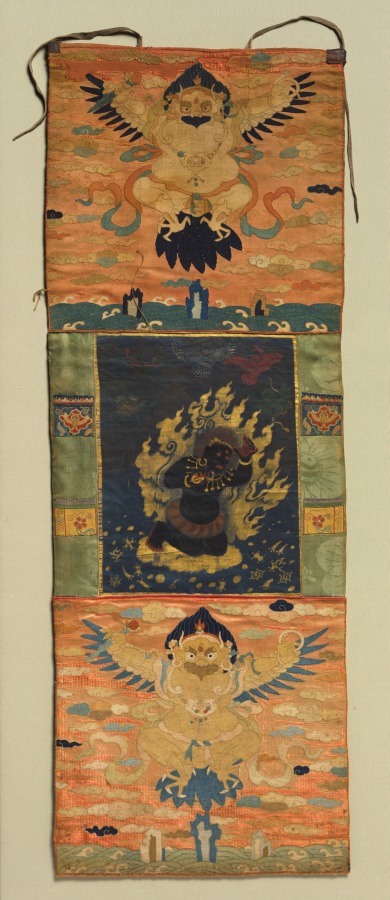
Vajrapani and Garuda
Choying Dorje, the Tenth Black Hat KarmapaLinkedCulture matchlcp-6ffad5880f55
- Date
- painting c. 1650; top and bottom borders c. 1350
- Medium
- Painting: gum tempera, gold, and silver on silk; lateral borders: silk damask with needleloop embroidery; top and bottom panels: embroidered silk, lead, and silver paper; curtain: silk tabby; dowels: wood, rawhide, and leather
- Culture
- China and Tibet, Embroidery: China, Yuan dynasty (1279–1368); painting: Tibet
- Department
- Textiles
- Institution
- Cleveland Museum of Art
- Object ID
- 154391
From the Cleveland Museum of Art record
The painting depicts the Buddhist protector who holds ( pani ) the thunder bolt ( vajra ) in his right hand. He kneels in reverence and holds his left hand in a gesture of salute. This unusual image appears to have been the vision of a Tibetan monastic patriarch known for creating his own inventive paintings and sculptures. Sewn to the painting are Chinese damask borders and rare embroideries dating to the Chinese Yuan dynasty (1279–1368). They depict man-eagle figures known as Garuda, a form occasionally assumed by Vajrapani. Vajrapani sometimes takes the form of Garuda, enemy of snakes.
The authoritative record is held by Cleveland Museum of Art. LinkedCulture surfaces this object and its connections; it does not alter institutional metadata.
Get printable QR codesHide QR codes
Open QR codes for this object page and the museum record. They stay collapsed until needed.
Provenance & credit
As published by the source institution. Coverage varies — not every institution's open-data feed includes ownership history.
- Credit line
- Purchase from the J. H. Wade Fund
- Provenance
- ?–1989: (Sara Tremayne, Ltd., London, England, sold to the Cleveland Museum of Art) | 1989–: The Cleveland Museum of Art, Cleveland, OH
Related across collections
Semantically similar works from Cleveland Museum of Art and other institutions.