Cleveland Museum of Art
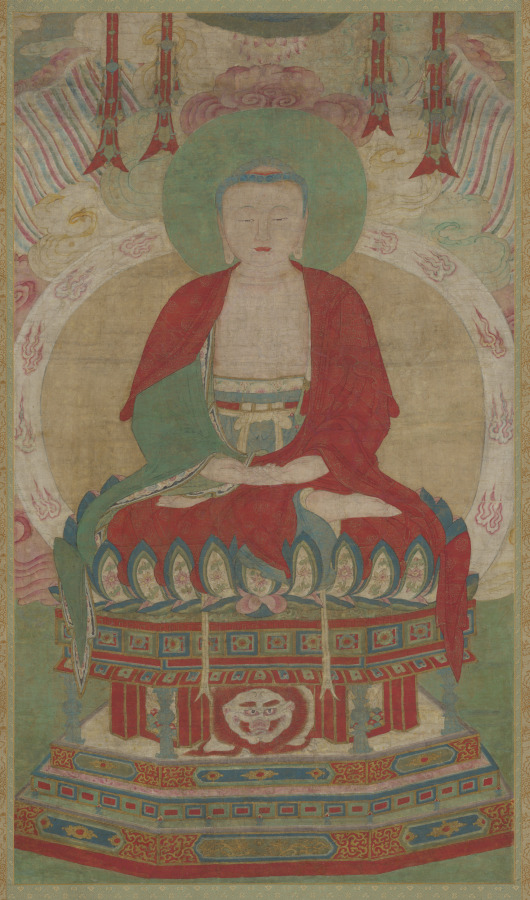
Seated Amitābha
- Date
- late 1500s–early 1600s
- Medium
- hanging scroll; ink and color on silk
- Culture
- Chinese, Ming dynasty (1368-1644)
- Department
- Chinese Art
- Institution
- Cleveland Museum of Art
- Object ID
- 157563
From the Cleveland Museum of Art record
This magnificent Buddha, called Amitābha (literally, “infinite light”) is seated on a lotus pedestal with both palms facing up over crossed legs, suggesting that it is in deep meditation. In contrast to the richly ornamented throne on which the Buddha is seated, the figure itself is devoid of any jewelry or decorative attributes, emphasizing its enlightened status and detachment from worldly affairs. The lion head in the center of the pedestal is a motif from Central Asia, which can also be seen in the halo or nimbus of Chinese Buddhist stone steles. Originally, this scroll was acquired by the museum as a Korean work, but has now been tentatively reattributed as Ming period Chinese.
The authoritative record is held by Cleveland Museum of Art. LinkedCulture surfaces this object and its connections; it does not alter institutional metadata.
Get printable QR codesHide QR codes
Open QR codes for this object page and the museum record. They stay collapsed until needed.
Provenance & credit
As published by the source institution. Coverage varies — not every institution's open-data feed includes ownership history.
- Credit line
- Gift of David S. Utterberg and the Severance and Greta Millikin Purchase Fund
- Provenance
- ?–1994: (R-L Sneider Inc., New York, NY, sold to the Cleveland Museum of Art) | 1994–: The Cleveland Museum of Art, Cleveland, OH
Related across collections
Semantically similar works from Cleveland Museum of Art and other institutions.