Cleveland Museum of Art
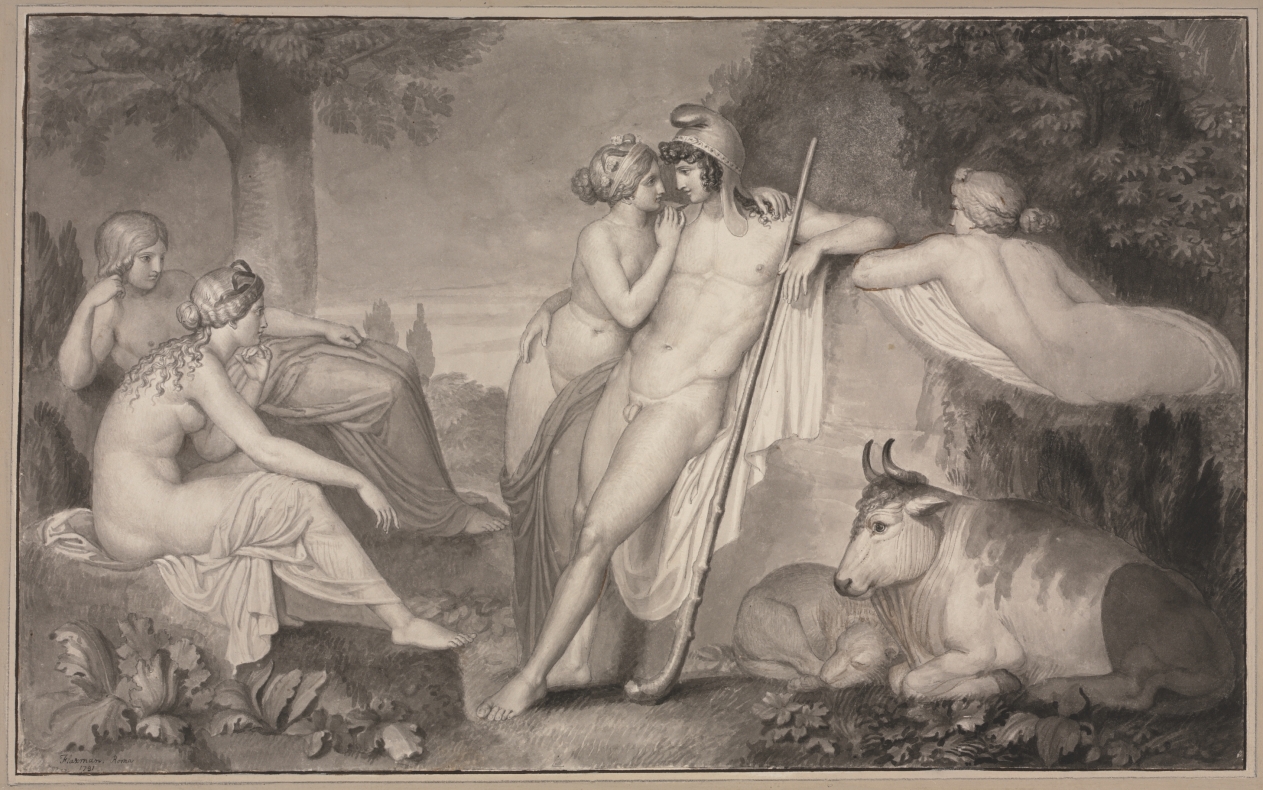
Paris and Oenone
John FlaxmanLinkedCulture matchlcp-04fb361b6100
- Date
- 1791
- Medium
- brush and gray wash with pen and pale gray-black ink with graphite and brown ink
- Culture
- England, 18th century
- Department
- Drawings
- Institution
- Cleveland Museum of Art
- Object ID
- 166628
From the Cleveland Museum of Art record
Although he identified himself first and foremost as a sculptor, John Flaxman’s greatest fame and most lasting influence rest with his drawings. Engravings made after his spare designs illustrating classical epics by Homer, Dante, and Hesiod became the most celebrated work in his oeuvre and spread his stylized linearity widely. This highly finished, signed and dated drawing was made while Flaxman was in Rome and needed to supplement his income while trying to obtain commissions for sculpture. Flaxman chose an obscure classical subject: the famous Trojan shepherd, Paris, with his first love, the nymph Oenone. The scene takes place on Mount Ida, in an idyllic time of peace before Paris was called upon to judge the beauty of the goddesses Hera, Athena, and Aphrodite, thus instigating the Trojan War. John Flaxman called his drawings "outlines," referring to their sparse style.
The authoritative record is held by Cleveland Museum of Art. LinkedCulture surfaces this object and its connections; it does not alter institutional metadata.
Get printable QR codesHide QR codes
Open QR codes for this object page and the museum record. They stay collapsed until needed.
Provenance & credit
As published by the source institution. Coverage varies — not every institution's open-data feed includes ownership history.
- Credit line
- Purchase from the J. H. Wade Fund
- Provenance
- ?-?: Marquis de Lagoy [1764-1829; L. 1710] | ?-?: By repute, from a member of the William Randolph Hearst family | ?-?: (Alexander Acevedo, Alexander Gallery, New York, NY) | ?-?: Private Collector, New York, NY | ?-2008: (Monroe Warshaw, New York, NY, sold to the Cleveland Museum of Art, Cleveland, OH) | 2008-: Cleveland Museum of Art, Cleveland, OH
Related across collections
Semantically similar works from Cleveland Museum of Art and other institutions.