Cleveland Museum of Art
Brazier with Coins Motif
Seifū Yohei IIILinkedCulture matchlcp-76f8f3f7462b
- Date
- 1893–1914
- Medium
- Stoneware with underglaze iron oxide designs and crackling
- Culture
- Japan, Meiji period (1868–1912)
- Department
- Japanese Art
- Institution
- Cleveland Museum of Art
- Object ID
- 447804
What the image shows
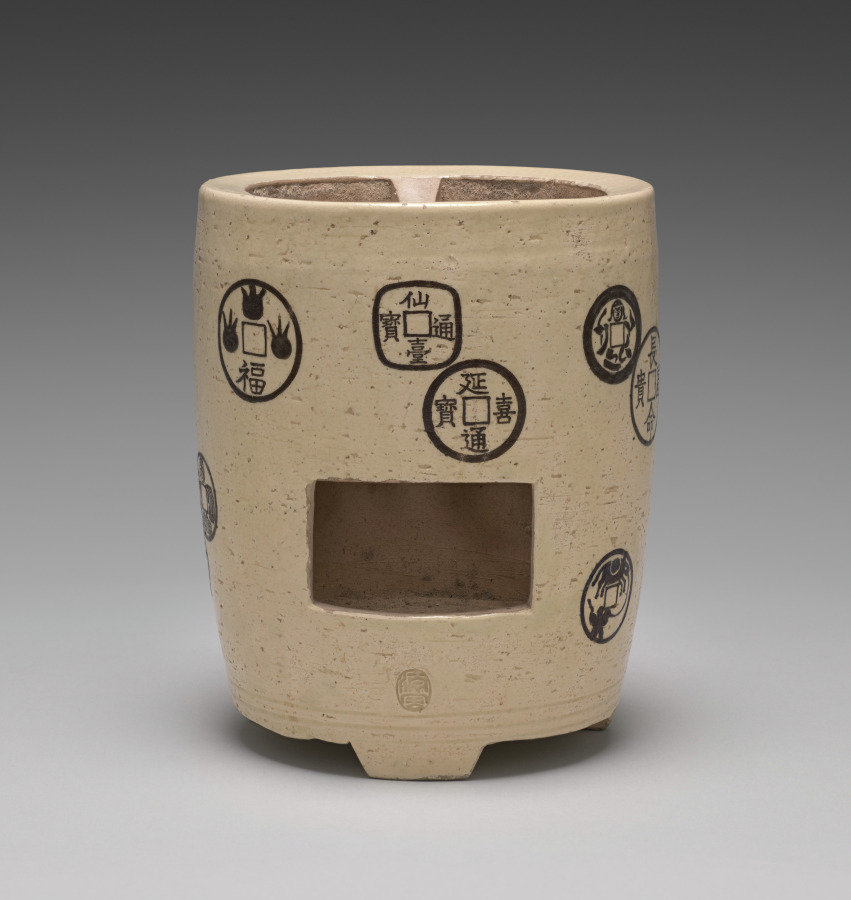
A cylindrical ceramic object with a circular opening on top and a rectangular cutout on the side.
Generated by LinkedCulture from the photograph alone, without the museum’s catalogue text (Qwen/Qwen2.5-VL-7B-Instruct), and not yet reviewed by a person. It describes the picture, not the object’s history, and it is not part of the museum’s record.
From the Cleveland Museum of Art record
Tall pottery braziers called ryōro are often used to heat the water for the tea served at sencha gatherings. This one sits on three sturdy legs, one of which bears the artist’s seal on its face. A horizontal rectilinear opening above this leg allows air to circulate into the lower part of the brazier. The top part is outfitted with three prongs onto which the kettle can be lowered; below them is a basin, perforated with circular holes, that holds the charcoal fuel. The brazier is decorated under the crackled transparent glaze with a design of old coins in iron oxide. The motif is cleverly chosen, for most older coins are round with a central hole, often square, which echoes the cylindrical form of the brazier with its rectilinear “wind gate,” or fūmon . One coin is painted with the Japanese god of wealth, Daikokuten, standing upon two bales of rice.
The authoritative record is held by Cleveland Museum of Art. LinkedCulture surfaces this object and its connections; it does not alter institutional metadata.
Get printable QR codesHide QR codes
Open QR codes for this object page and the museum record. They stay collapsed until needed.
Provenance & credit
As published by the source institution. Coverage varies — not every institution's open-data feed includes ownership history.
- Credit line
- Gift of James and Christine Heusinger
- Provenance
- ?–2022: James and Christine Heusinger, Berea, OH, given to the Cleveland Museum of Art | 2022–: The Cleveland Museum of Art, Cleveland, OH
Related across collections
Semantically similar works from Cleveland Museum of Art and other institutions.