Cleveland Museum of Art
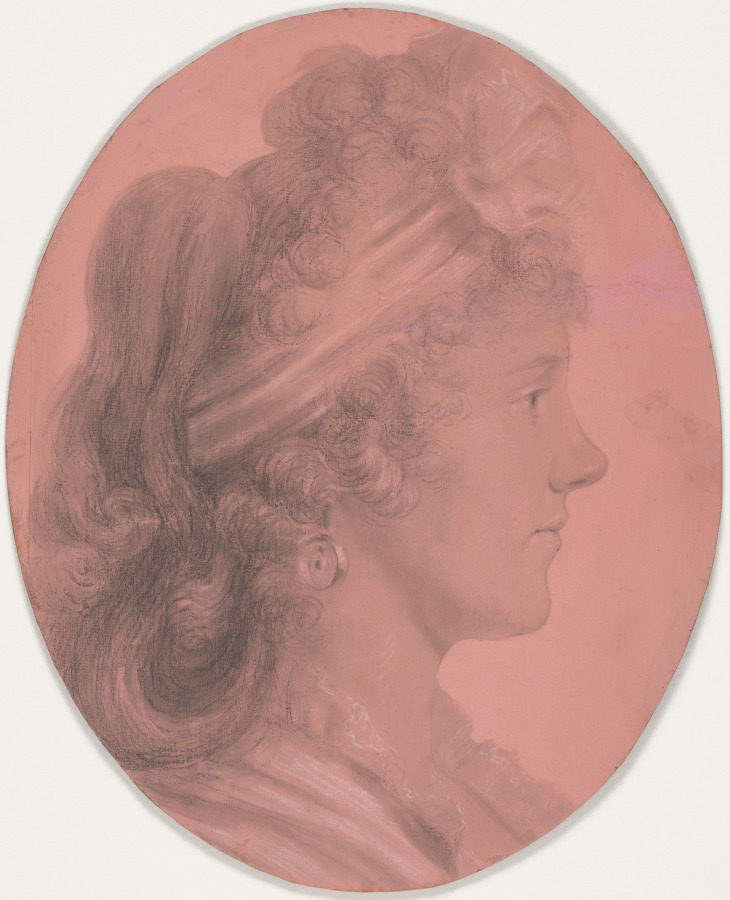
Portrait of Eleanor Ramsay Fitzwilliam
Charles Balthazar Julien Fevret de Saint-MéminLinkedCulture matchlcp-b3155f63404c
- Date
- c. 1790–1852
- Medium
- Black and white chalk on buff paper with pink wash in original frame
- Culture
- France
- Department
- Drawings
- Institution
- Cleveland Museum of Art
- Object ID
- 672131
From the Cleveland Museum of Art record
This portrait and its pair (2024.35.1), depict George Fitzwilliam, an English merchant, and his American wife Eleanor Ramsay Fitzwilliam, who sat in New York for the French émigré artist Charles Balthazar Julien Févret de Saint-Mémin. Saint-Mémin used a recently invented mechanical device called a physiognotrace to trace accurate profiles of his sitters, which he then completed in black and white chalks. The technology enabled Saint-Mémin to establish a thriving business catering to prominent Americans—including Presidents Washington, Adams, Jefferson, and Madison, Benjamin Franklin, and several Native American chiefs—at a time when he was in exile from the French Revolution. As part of each commission, Saint-Mémin also supplied etchings of the portrait in a reduced size, which could be given as keepsakes to family and friends. The physiognotrace device used to create this portrait consisted of a wooden frame within which a sitter posed in profile; the artist then peered through an eyepiece and followed the contour and features of the sitter’s face by maneuvering a graphite pencil attached to the mechanism.
The authoritative record is held by Cleveland Museum of Art. LinkedCulture surfaces this object and its connections; it does not alter institutional metadata.
Get printable QR codesHide QR codes
Open QR codes for this object page and the museum record. They stay collapsed until needed.
Provenance & credit
As published by the source institution. Coverage varies — not every institution's open-data feed includes ownership history.
- Credit line
- Alma Kroeger Fund
- Provenance
- ?–2024: (Marty de Cambiaire Master Paintings & Drawings, New York, NY), sold to The Cleveland Museum of Art, Cleveland, OH | June 3, 2024–: The Cleveland Museum of Art, Cleveland, OH
Related across collections
Semantically similar works from Cleveland Museum of Art and other institutions.