Cleveland Museum of Art
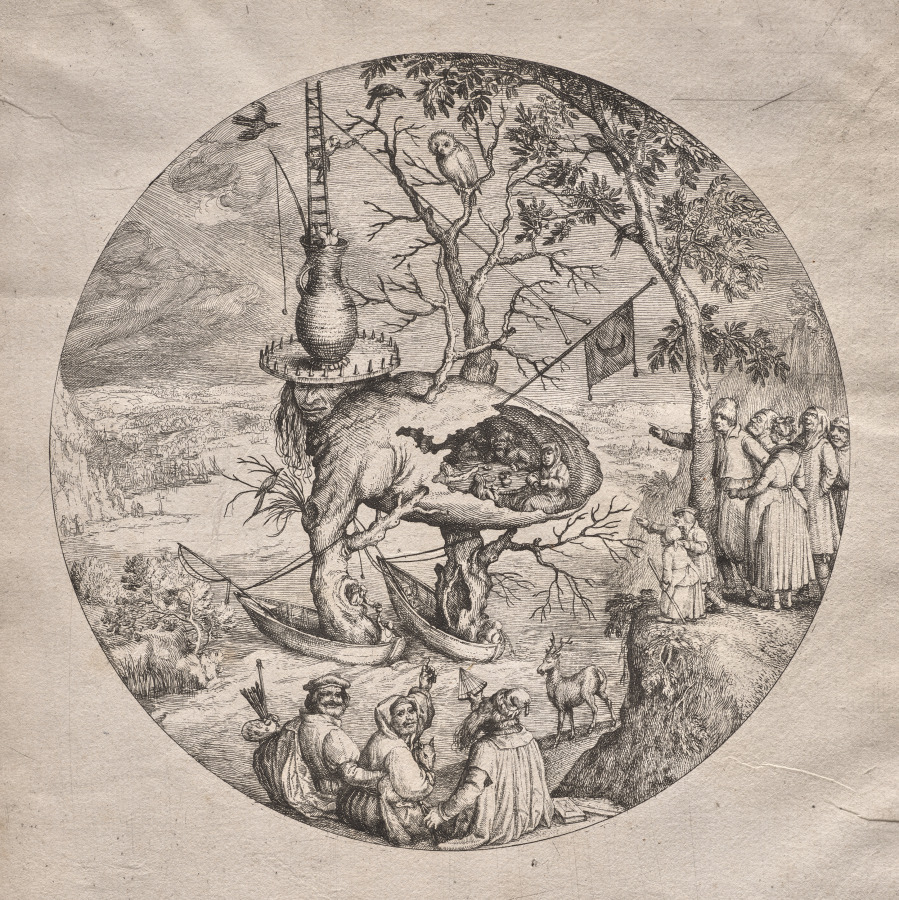
The Tree Man
Hieronymous BoschLinkedCulture matchlcp-50cc54a2f0d6
- Date
- c. 1560–1600, first edition printed c. 1715
- Medium
- etching and engraving
- Culture
- Netherlands
- Department
- Prints
- Institution
- Cleveland Museum of Art
- Object ID
- 691399
From the Cleveland Museum of Art record
Hieronymus Bosch is largely considered the first European artist to give free rein to his imagination, as embodied in his depiction of fantastic, often diabolical creatures in the context of the traditional Catholic altarpiece. Based on a drawing by Bosch now at the Albertina Museum, Vienna, this etching of the Tree Man cleverly and uncannily merges anthropomorphic, organic, and man-made elements into a monstrous creature who stands at the center. The creature combines various proverbial subjects that appear throughout Bosch’s oeuvre, such as a ship of fools (denoting collective foolishness), and a cracked egg (a symbol of earthly vanity). Onlookers to the right and below act as witnesses to the folly. In the Christian context within which Bosch made the composition, the figure may broadly be understood as an image of sinful decrepitude. Yet, the Tree Man’s significance cannot be reduced to single, definitive meaning. At the bottom of the composition Bosch portrays a painter, an astronomer, and an Aesopian figure (or fableist), practitioners who use illusion to convey the world’s truths, and might be interpreted as Bosch himself.
The authoritative record is held by Cleveland Museum of Art. LinkedCulture surfaces this object and its connections; it does not alter institutional metadata.
Get printable QR codesHide QR codes
Open QR codes for this object page and the museum record. They stay collapsed until needed.
Provenance & credit
As published by the source institution. Coverage varies — not every institution's open-data feed includes ownership history.
- Credit line
- Severance and Greta Millikin Purchase Fund
- Provenance
- Georges Laclanché [1838-1882], Paris, France | his brother, Maurice Laclanché [1847-1921], Paris, France | his daughter and her husband, Marianne Laclanché [1880-?] and Marcel Lecarrière [1873-?], Paris, France | their son, Christian Lecarrière [1906-1995], Paris and La Croix-Valmer | his daughter, Catherine Edou Lacarrière [?-ca. 2015] | March 29, 2024: Sold, De Baecque, Paris, France, Friday, March 29, 2024 - 2pm, lot 46 | 2024–25: (Hill-Stone, Inc., New York, NY, sold to The Cleveland Museum of Art, Cleveland, OH) | June 9, 2025–: The Cleveland Museum of Art, Cleveland, OH
Related across collections
Semantically similar works from Cleveland Museum of Art and other institutions.