Getty Museum
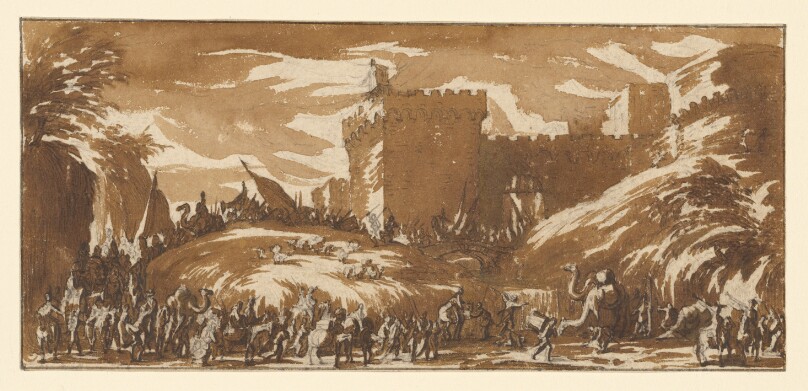
An Army Leaving a Castle
Creator
Jacques CallotFrench Artist · 1592–1635
All works by this person →Legend has it that little Jacques Callot so wanted to be an artist in Rome that he twice ran away from his wealthy parents' home at the duke of Lorraine's court. By 1608 he had apprenticed to engraver and publisher Philippe Thomassin, learning line engraving and copying Flemish art and late Mannerist works in Roman churches. Callot's career really began in Florence in 1612, however, when he began
More on Getty ULAN- Date
- about 1632
- Medium
- Brush and brown wash over black chalk
- Culture
- French
- Department
- Drawings
- Institution
- Getty Museum
- Object ID
- 06848f6d-d2f5-4454-9906-f6f13fecafce
From the Getty Museum record
Jacques Callot's bravura handling of wash, the expansiveness of the setting, and the large number of participants belie this sheet's tiny size. Callot typically created small prints and drawings whose action and setting may be best appreciated with a magnifying glass. The location and subject depicted in this drawing are unknown, but the camels indicate an Eastern locale. With rich use of wash and dramatic compositional rhythms, Callot invented a complex scene of an army marching in procession from a castle or walled city with captives and booty. Banners aloft, they regroup to trumpet fanfares in the lower right corner. Huge tongues of flame, seen clearly in the black chalk underdrawing, burst from the battlements. In style, subject, and horizontal format, this drawing resembles compositions from one of Callot's masterworks, his *Miseries of War* etchings of 1633. He completed the series soon after Cardinal Richelieu's devastating invasion of the Lorraine region and the capture of Callot's hometown of Nancy.
The authoritative record is held by Getty Museum. LinkedCulture surfaces this object and its connections; it does not alter institutional metadata.
Get printable QR codesHide QR codes
Open QR codes for this object page and the museum record. They stay collapsed until needed.
Related across collections
Semantically similar works from Getty Museum and other institutions.