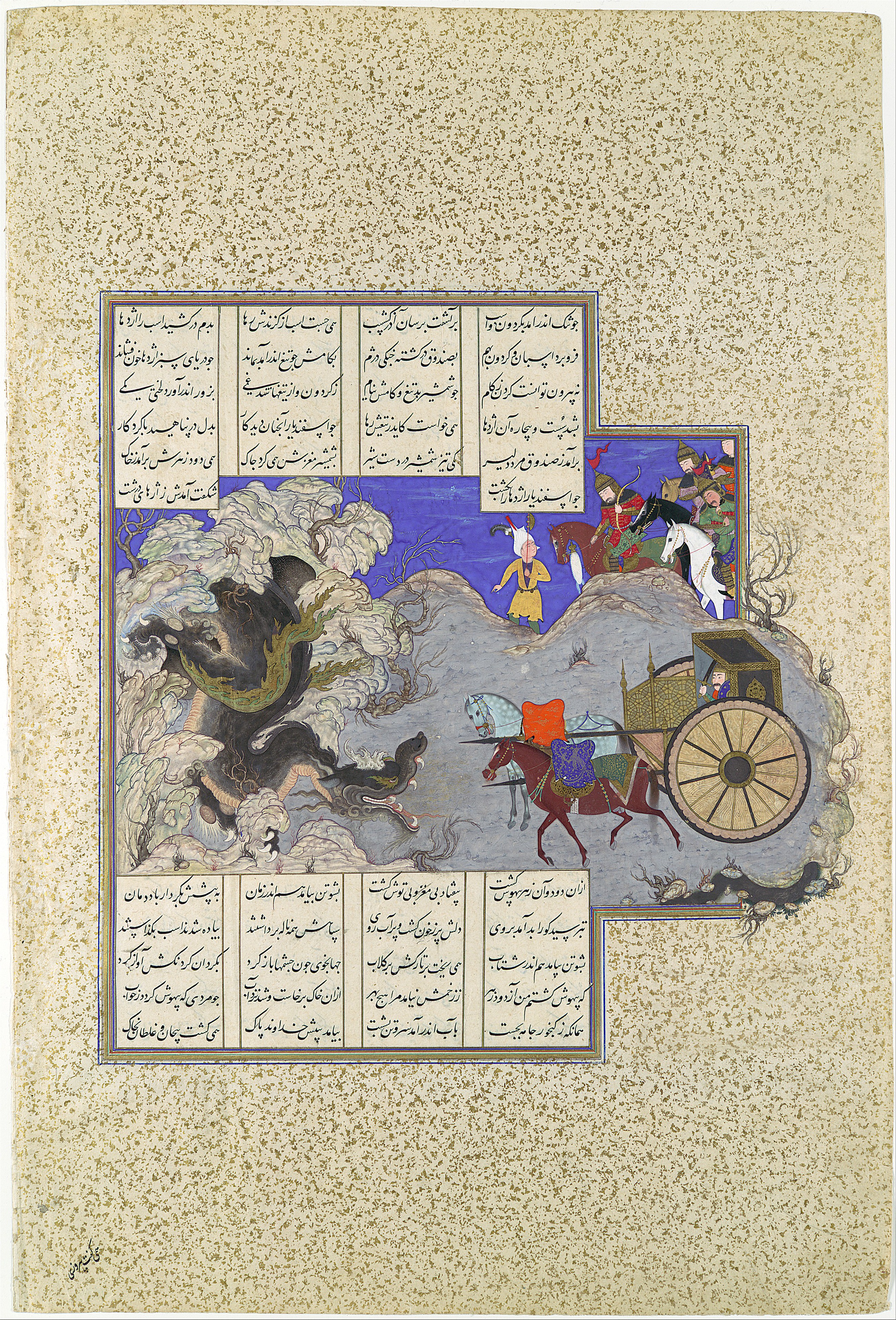
"Isfandiyar's Third Course: He Slays a Dragon", Folio 434v from the Shahnama (Book of Kings) of Shah Tahmasp

The Metropolitan Museum of Art

"Isfandiyar's Third Course: He Slays a Dragon", Folio 434v from the Shahnama (Book of Kings) of Shah Tahmasp

Abu'l Qasim Firdausi

Date
ca. 1530
Medium
Opaque watercolor, ink, silver, and gold on paper
Department
Islamic Art
Institution
The Metropolitan Museum of Art

The authoritative record is held by The Metropolitan Museum of Art. LinkedCulture surfaces this object and its connections; it does not alter institutional metadata.

Related across collections

Semantically similar works from The Metropolitan Museum of Art and other institutions.

Isfandiyar slays Arjasp, the king of Turan, from a Shah-nama (Book of Kings) of Firdausi (Persian, about 934–1020)

Isfandiyar slays Arjasp, the king of Turan, from a Shah-nama (Book of Kings) of Firdausi (Persian, about 934–1020)

Cleveland Museum of Art

Bahram Gur Arrives at the House of a Merchant, text page (recto); Bahram Gur Slays a Dragon (verso), from a Shahnama (Book of Kings) of Firdausi (940–1019 or 1025), known as the Great Mongol Shahnama

Bahram Gur Arrives at the House of a Merchant, text page (recto); Bahram Gur Slays a Dragon (verso), from a Shahnama (Book of Kings) of Firdausi (940–1019 or 1025), known as the Great Mongol Shahnama

Cleveland Museum of Art

Bahram Gur Slays a Dragon (verso), from a Shahnama (Book of Kings) of Firdausi (940–1019 or 1025), known as the Great Mongol Shahnama

Bahram Gur Slays a Dragon (verso), from a Shahnama (Book of Kings) of Firdausi (940–1019 or 1025), known as the Great Mongol Shahnama

Cleveland Museum of Art

Rustam's seventh course: He kills the White Div, folio 124 from a Shah-nama (Book of Kings) of Firdausi (Persian, about 934–1020)

Rustam's seventh course: He kills the White Div, folio 124 from a Shah-nama (Book of Kings) of Firdausi (Persian, about 934–1020)

Cleveland Museum of Art

Bahram Gur Arrives at the House of a Merchant, text page (recto), from a Shahnama (Book of Kings) of Firdausi (940–1019 or 1025), known as the Great Mongol Shahnama

Bahram Gur Arrives at the House of a Merchant, text page (recto), from a Shahnama (Book of Kings) of Firdausi (940–1019 or 1025), known as the Great Mongol Shahnama

Cleveland Museum of Art

King Luhrasp Ascends the Throne: a Processon Arrives at Court, recto of the left folio of a double-page composition from a Shahnama (Book of Kings) of Firdausi (940-1019 or 1025)

King Luhrasp Ascends the Throne: a Processon Arrives at Court, recto of the left folio of a double-page composition from a Shahnama (Book of Kings) of Firdausi (940-1019 or 1025)

Cleveland Museum of Art

Bahram Gur and Azada, from a Shahnama (Book of Kings) of Firdausi (940–1019 or 1025)

Bahram Gur and Azada, from a Shahnama (Book of Kings) of Firdausi (940–1019 or 1025)

Cleveland Museum of Art

Rustam's seventh course: He kills the White Div, folio 124 from a Shah-nama (Book of Kings) of Firdausi (Persian, about 934–1020)

Rustam's seventh course: He kills the White Div, folio 124 from a Shah-nama (Book of Kings) of Firdausi (Persian, about 934–1020)

Cleveland Museum of Art

Page from a Shah-nama (Book of Kings) of Firdausi (Persian, about 934–1020)

Page from a Shah-nama (Book of Kings) of Firdausi (Persian, about 934–1020)

Cleveland Museum of Art

"Rustam Blames Kai Kavus for the Death of Siyavush", Folio 202v from the Shahnama (Book of Kings) of Shah Tahmasp

"Rustam Blames Kai Kavus for the Death of Siyavush", Folio 202v from the Shahnama (Book of Kings) of Shah Tahmasp

The Metropolitan Museum of Art

Page from a Shah-nama (Book of Kings) of Firdausi (Persian, about 934–1020)

Page from a Shah-nama (Book of Kings) of Firdausi (Persian, about 934–1020)

Cleveland Museum of Art

King Luhrasp Ascends the Throne: a Processon Arrives at Court (recto); the Story of King Luhrasp (verso) from a Shahnama (Book of Kings) of Firdausi (940-1019 or 1025)

King Luhrasp Ascends the Throne: a Processon Arrives at Court (recto); the Story of King Luhrasp (verso) from a Shahnama (Book of Kings) of Firdausi (940-1019 or 1025)

Cleveland Museum of Art