Research note · October 17, 2026
The frog on someone else's paper
A cover in Chicago and a frog in Minneapolis reveal the collector, collaborators, and reused Japanese paper behind a French print portfolio.
linkedculturejaponismeprintmakingprovenancecrossinstitutional
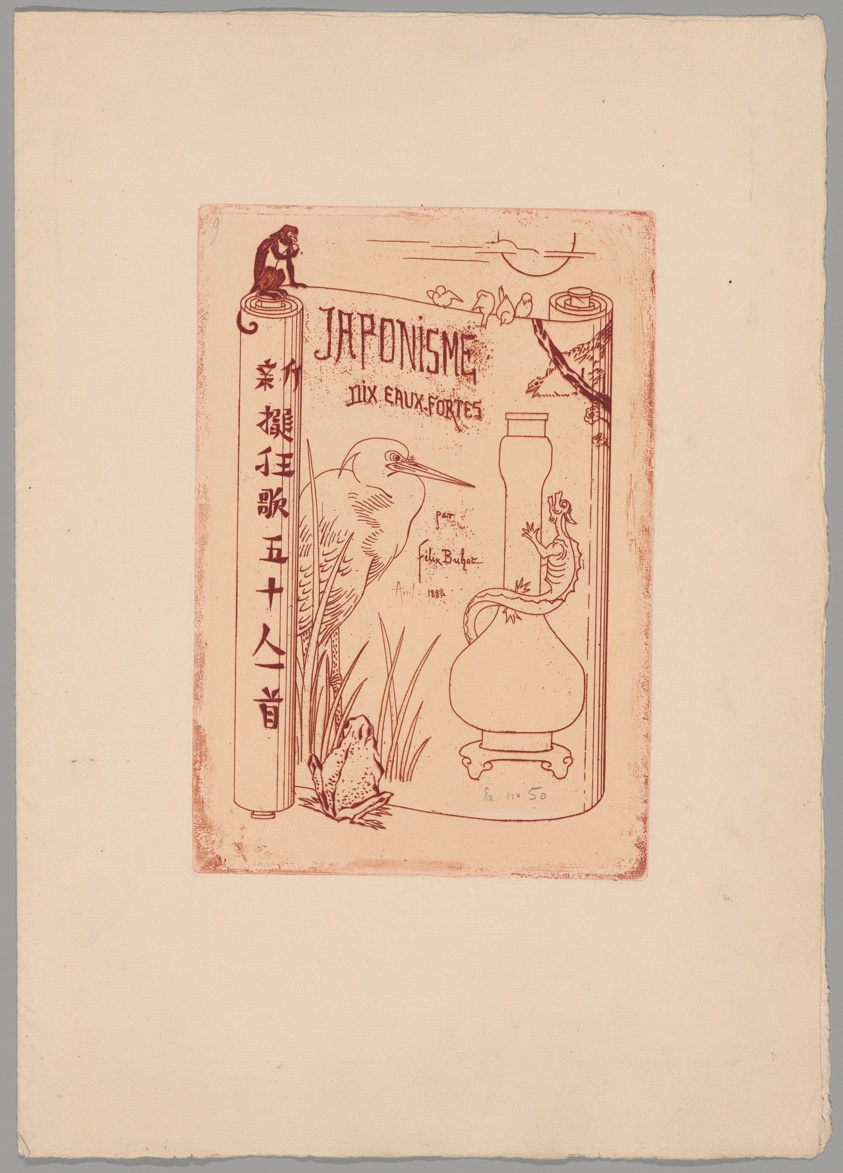
A monkey sits on a rolled scroll. Below it are a long-legged bird, a frog, and a vase around which a small reptile climbs. Between them, in red ink, the lettering announces Japonisme: Dix Eaux-Fortes, followed by Félix Buhot's name and April 1883. The printed cover in Chicago gives you an artist and a title. It leaves the other participants to be found elsewhere.[1]
The Bibliothèque nationale de France credits the cover to Henri Guérard, a printmaker who worked as Manet's master printer and was married to the painter Eva Gonzalès, while naming Buhot as the maker of the ten etchings inside.[11] Its catalog also identifies the collection that supplied their subjects: Japanese objects owned by the critic Philippe Burty.[2] The portfolio carries Buhot's name, but even its enclosure leads to another maker.
Burty is usually introduced as the critic credited with naming Japonisme in 1872. The Library of Congress connects him to this portfolio in a more tangible way: the ten etchings were based on objects in his collection.[3] He supplied both a word for the enthusiasm and things an artist could sit down to study.
Buhot had access to Burty's collection through their friendship. The Palmer Museum's exhibition essay dates his etchings after the objects to 1875 and their compilation as Japonisme to 1883, alongside Louis Gonse's Japanese-art retrospective at the Georges Petit gallery.[4] Objects gathered privately were becoming images that could circulate beyond the collection.
The inkwell and the sheet
In Minneapolis, Bronze Frog Inkwell, from Japonisme shows how far Buhot could take that translation. A large frog sits in the foreground, its head raised and its front feet spread. Above it is another view of the object, turned to expose a different aspect of its form and placed in what the museum describes as a moonlit setting.[5]
Look beyond the etched rectangle. Large Japanese characters and red marks occupy the surrounding sheet. According to Minneapolis's curatorial account, Buhot printed on a found piece of Japanese paper, using its calligraphy and stamps for their visual effect rather than their literal meaning.[5]
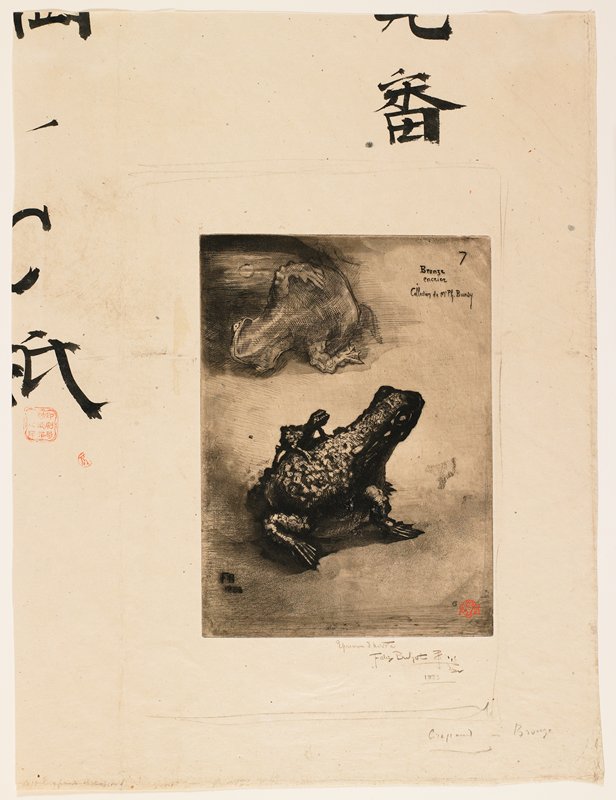
The sheet brings two histories together. Burty's inkwell has become an image; the paper already had a life before Buhot printed on it. Its writing extends beyond his composition and gives the finished work a scale and texture that the copperplate alone could not supply. You can see the relationship without yet knowing what the characters say.
A reader familiar with Japanese calligraphy may be able to identify the text and the sheet's earlier purpose.
Inside the wrappers
A complete set at the National Gallery of Art preserves relationships that are harder to follow through separate sheets. Acquired in 2023, it contains ten etchings on Japanese paper inside two printed wrappers. The set is cataloged under Buhot, while the wrapper records also name Guérard.[6] [7]
The outer wrapper has the title image on its front and a butterfly-and-dragonfly image on its back. A separate Titre sheet in the set is also cataloged with both artists' names.[7] [8] If you encounter one component on its own, the portfolio title can conceal that division of work. Comparing it with the intact set gives you another level of attribution to check.
The Washington set also brings its publisher into view. The National Gallery identifies Edmond Sagot as its dedicatee and begins the recorded provenance with him, followed by Eric G. Carlson and Ars Libri before the 2023 acquisition.[6] The BnF names E. Sagot as publisher.[2] The person who helped put the portfolio into circulation also appears at the beginning of this copy's ownership history. The abbreviated provenance leaves gaps between those names, but the publishing and ownership roles are both recorded. Sagot's imprint also appears in the Library of Congress entry, which dates its copy to 1885; Chicago dates its cover to 1883, while the BnF gives 1883 or 1885.[1] [2] [3] The records leave the publication history open for a closer comparison of editions and states.
The title and the object
A Bridge in the Rain previously linked Chicago object 262015 as though it were the cover. I followed that link and found a mask. The red cover illustrated here is 262014.[1] [9] Both records are titled Japonisme. The correction took an image check, because the shared title could not distinguish the objects.
That is also why the frog's paper matters. The portfolio name groups the prints together, but their individual sheets retain details of how the project was made: another printmaker's cover, a publisher's copy, writing that existed before the image printed over it. Following those connections requires more than finding the same word in several catalogs. It requires asking what, exactly, has survived under it.
Research route
A LinkedCulture MCP search for Japonisme Buhot brought the Chicago cover into the same result set as the Minneapolis frog and related portfolio sheets.[10] I followed those object records into the museums' own data, then consulted the BnF, Palmer Museum, Library of Congress, and National Gallery sources listed below. The cross-collection search supplied the route from a portfolio title to the particular objects discussed here.
References
- [1]Art Institute of Chicago, Japonisme, 1883, 2021.321.2, object 262014. LinkedCulture record; museum data. Medium and artist fields; image inspected during this investigation.
- [2]Bibliothèque nationale de France, Japonisme: dix-eaux-fortes, FRBNF43827548. Catalog record. Cover credit, publication statement, and note on objects from Burty's collection. The record gives 1883 or 1885.
- [3]Library of Congress, “Japan and the West: Artistic Cross-Fertilization,” The Floating World of Ukiyo-e, item 89. Exhibition entry. Portfolio credited to Buhot, Paris: M. Edmond Sagot, 1885; relation to Burty's collection.
- [4]Hyoungee Kong, “Buhot and Japonisme,” Félix Buhot: Printmaker of Nineteenth-Century France, Palmer Museum of Art/Penn State. Exhibition essay. Access to collections and the relationship between the 1875 etchings, 1883 compilation, and exhibition.
- [5]Minneapolis Institute of Art, Bronze Frog Inkwell, from Japonisme, 1883, P.1,857, object 54330. LinkedCulture record; museum record; museum data. Curatorial text, credit, and public-domain image designation.
- [6]National Gallery of Art, Japonisme, 1883, 2023.90.1.1-12. Portfolio record. Ensemble structure, dedicatee, and recorded provenance.
- [7]National Gallery of Art, Titre / Ex-libris papillon et libellule, 1883, 2023.90.1.1.a-b. Wrapper record. Associated artists and front/back composition.
- [8]National Gallery of Art, Titre, 1883, 2023.90.1.3. Sheet record. Artists and support.
- [9]Art Institute of Chicago, Japonisme, 1883, 2021.321.3, object 262015. LinkedCulture record; museum data. The associated image depicts the mask rather than the title cover.
- [10]LinkedCulture MCP, query
Japonisme Buhot, limit 25, retrieved 17 October 2026. Identifiable results include ARTIC-262014, MIA-54330, MIA-54338, and RIJKS-RP-P-1913-1408. Search response retained in the research dossier.
- [1]Cleveland Museum of Art, An African Woman, after Eva Gonzalès, c. 1888, 2020.241. Museum record. Curatorial account identifies Guérard as a master printer for Manet and Gonzalès's spouse.
In this note
Records
3 objects in the LinkedCulture index. Each page links on to the holding museum.