Art Institute of Chicago
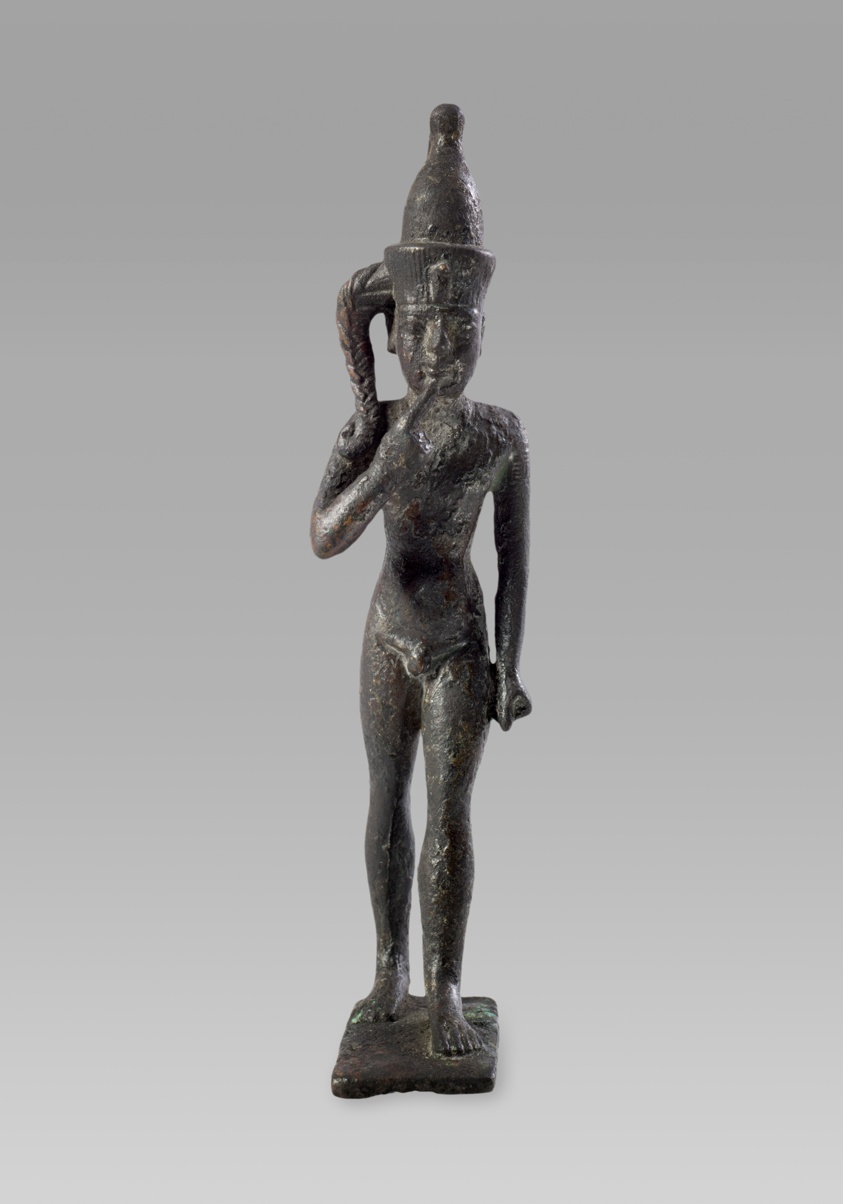
Statuette of Horus the Child (Harpokrates)
EgyptianLinkedCulture matchlcp-b3f2759025d0
- Date
- Late Period (664-332 BCE)
- Medium
- Copper alloy
- Culture
- Egypt
- Department
- Arts of Africa
- Institution
- Art Institute of Chicago
- Object ID
- 141006
From the Art Institute of Chicago record
According to ancient Egyptian myth, the god Horus was the son of Isis and her brother/husband Osiris, ruler of the underworld. Before Horus was born, Seth, the god of disorder and also Osiris’s brother, murdered the king in a quest for Egypt’s throne—but the gods elevated Horus as heir instead. This statuette shows him wearing the Double Crown, or pschent, which combines the crown of Upper (southern) Egypt with that of Lower (northern) Egypt, signifying Horus’s dominion over the whole realm. Here the young god places his right index finger to his lips in a gesture that ancient Egyptians understood as a sign for childhood. His youthfulness is further underscored by his nakedness and the “sidelock of youth,” a single braid on the side of his head, which was a common hairstyle for Egyptian children. In later periods this form of the god was worshiped under the Greek name Harpokrates, which comes from the Egyptian “Hor-pa-khered,” meaning “Horus the child.”
The authoritative record is held by Art Institute of Chicago. LinkedCulture surfaces this object and its connections; it does not alter institutional metadata.
Get printable QR codesHide QR codes
Open QR codes for this object page and the museum record. They stay collapsed until needed.
Provenance & credit
As published by the source institution. Coverage varies — not every institution's open-data feed includes ownership history.
- Credit line
- Gift of Henry H. Getty, Charles L. Hutchinson, and Robert H. Fleming
Linked open data
Authority identifiers that link this record into the wider web of cultural data — stable references you can follow to the source.
- Object type
- AAT300301253
Related across collections
Semantically similar works from Art Institute of Chicago and other institutions.