Art Institute of Chicago
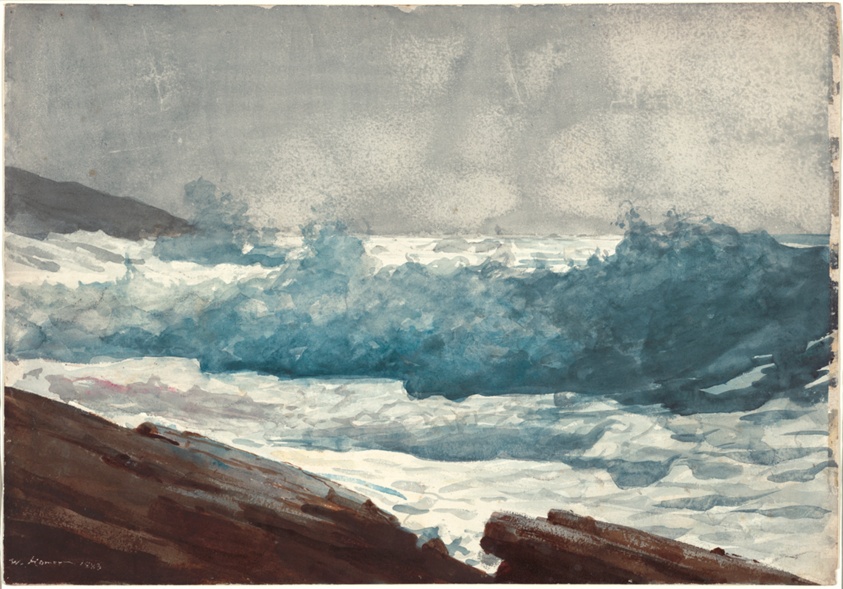
Prout's Neck, Breakers
Winslow HomerLinkedCulture matchlcp-bcddaaacf48f
- Date
- 1883
- Medium
- Watercolor, with blotting and sanding, over charcoal, on moderately thick, moderately textured, ivory wove paper
- Culture
- United States
- Department
- Prints and Drawings
- Institution
- Art Institute of Chicago
- Object ID
- 16815
From the Art Institute of Chicago record
Homer’s decision to move to Maine in 1883 presumably indicated his desire to live close to nature—Prout’s Neck was a peninsula known for its rocky coastline and dramatic views of the Atlantic Ocean. Prout’s Neck, Breakers , later the model for the monumental oil painting Early Morning after a Storm at Sea , shows the artist’s continued fascination with the power of the sea. However, unlike his earlier marine works, this and other watercolors made at Prout’s Neck are usually devoid of human activity, exploring nature’s grandeur in its many manifestations. This work also exemplifies important aspects of Homer’s technique as a watercolorist, including the way he layered strokes of color—using a range of light and dark blues—to create the depth and force of the breaking waves. He used the white of the paper to produce a brilliant sheen on the sea, juxtaposed with a hazy sky above.
The authoritative record is held by Art Institute of Chicago. LinkedCulture surfaces this object and its connections; it does not alter institutional metadata.
Get printable QR codesHide QR codes
Open QR codes for this object page and the museum record. They stay collapsed until needed.
Provenance & credit
As published by the source institution. Coverage varies — not every institution's open-data feed includes ownership history.
- Credit line
- Mr. and Mrs. Martin A. Ryerson Collection
- Provenance
- The artist to his brother, Charles S. Homer, Jr. (1834–1917), New York, by 1910 [according to correspondence from Abigail Booth Gerdts to the Art Institute, February 10, 2007]. Charles W. Gould (1849–1931), New York, by 1915 [Brooklyn exh. cat. 1915]. Sold by Knoedler and Company, New York, Martin A. Ryerson (1856–1932), Chicago, November 11, 1915 [invoice]; given to the Art Institute, 1933.
Linked open data
Authority identifiers that link this record into the wider web of cultural data — stable references you can follow to the source.
- Object type
- AAT300033973
Part of LinkedCulture topics
 American Landscape and Coastal Paintings
These works are 19th-century oil paintings depicting natural landscapes and seascapes from the northeastern United States, particularly coastal New England regions and rocky shores.
140 objects from 4 institutions
 American Watercolor Landscape Art
These objects are predominantly watercolor and drawing works by American artists depicting natural landscapes, outdoor recreational activities, and coastal or wilderness scenes from the 19th century.
63 objects from 3 institutions
Related across collections
Semantically similar works from Art Institute of Chicago and other institutions.