Art Institute of Chicago
Amphora (Storage Jar)
Attributed to the Ivy Leaf GroupLinkedCulture matchlcp-2f9143fdb18b
- Date
- 530-520 BCE
- Medium
- terracotta, black-figure
- Culture
- Etruria
- Department
- Arts of Greece, Rome, and Byzantium
- Institution
- Art Institute of Chicago
- Object ID
- 198337
From the Art Institute of Chicago record
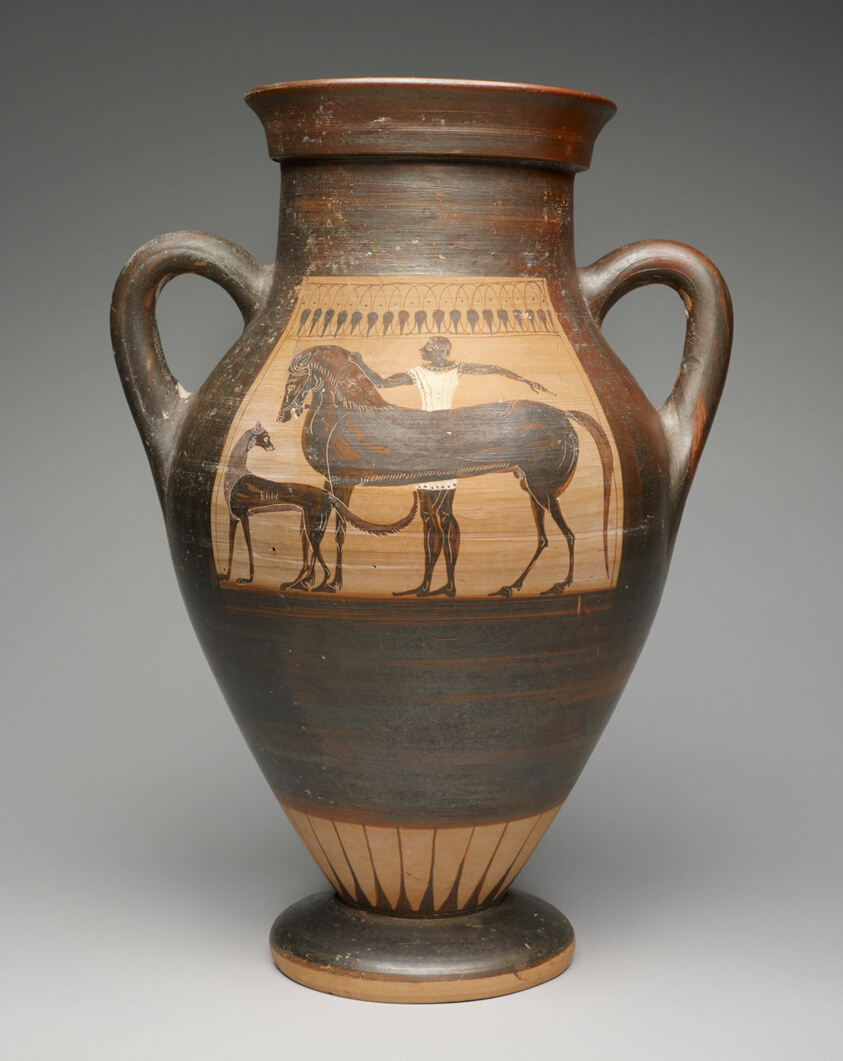
During the sixth and fifth centuries BC, the Etruscans, who lived north of Rome, increasingly imported Athenian ceramics decorated with scenes of Greek mythology, religion, and daily life. Made of fine, iron-rich clay that fired orange, decorated with a rich black gloss, and sometimes embellished with white and purple-red details, the ceramic vessels produced in Athens were the finest of Classical antiquity. Etruscan artists, no doubt eager to capitalize on the high demand for Greek vases, and perhaps also hoping to attract customers unable to afford the imported wares, set up a workshop, probably at Vulci, to produce facsimiles of the Athenian vases. This vessel’s attenuated proportions and symmetrical profile create an especially elegant shape that belies the somewhat coarse texture of the local Etruscan clay from which it is made. The clay’s poor quality also stymied attempts to replicate the highly refined surface finishes of Athenian vases. Nevertheless, the painter of this vase skillfully composed his scenes within trapezoidal picture fields bounded above by a decorative pattern of interlacing lotus buds and dots and along its sides by a single line. On the front, a hound looks back at a horse and hunter, while a stag and hare flee for their lives on the back.
The authoritative record is held by Art Institute of Chicago. LinkedCulture surfaces this object and its connections; it does not alter institutional metadata.
Get printable QR codesHide QR codes
Open QR codes for this object page and the museum record. They stay collapsed until needed.
Provenance & credit
As published by the source institution. Coverage varies — not every institution's open-data feed includes ownership history.
- Credit line
- Katherine K. Adler Memorial Fund
- Provenance
- T. Fujita, Tokyo, Japan and Lugano, Switzerland in the 1970's; in the collection of the Kurashiki Ninagawa Museum, Kurashiki, Okayama County, Japan, by 1980, then to the Kyoto Girishia Roma Bijutsukan, Kyoto, Japan, until about 2007; sold by Mr. Akira Ninagawa at aution through Christie's New York, New York, June 4, 2008, lot 225, to Phoenix Ancient Art, New York, New York; purchased by the Art Institute of Chicago, Chicago, Illinois in 2009.
Linked open data
Authority identifiers that link this record into the wider web of cultural data — stable references you can follow to the source.
- Object type
- AAT300193015
Related across collections
Semantically similar works from Art Institute of Chicago and other institutions.