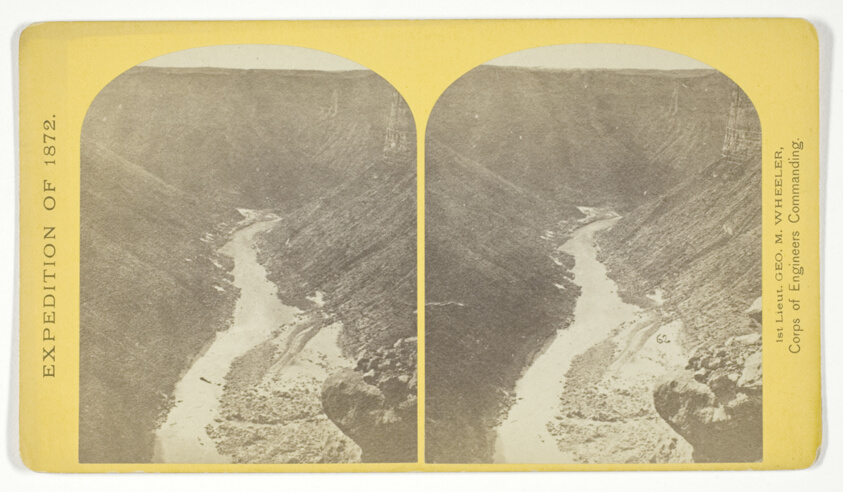
Marble Cañon, one of the gorges of the Colorado here, 1.200 feet deep. The steep cliff is gray limestone and the slope below a brilliant red sandstone, No. 13 from the series "Geographical Explorations and Surveys West of the 100th Meridian"

Art Institute of Chicago

Marble Cañon, one of the gorges of the Colorado here, 1.200 feet deep. The steep cliff is gray limestone and the slope below a brilliant red sandstone, No. 13 from the series "Geographical Explorations and Surveys West of the 100th Meridian"

William H. Bell (American, 1830–1910)

Date
1872
Medium
Albumen print, stereo
Culture
United States
Department
Photography and Media
Institution
Art Institute of Chicago

The authoritative record is held by Art Institute of Chicago. LinkedCulture surfaces this object and its connections; it does not alter institutional metadata.

Linked open data

Authority identifiers that link this record into the wider web of cultural data — stable references you can follow to the source.

Object type
AAT300046300

Related across collections

Semantically similar works from Art Institute of Chicago and other institutions.

Marble Canon, one of the gorges of the Colorado, here 1,200 feet deep. The steep cliff is gray limestone...slope..red limestone.

Marble Canon, one of the gorges of the Colorado, here 1,200 feet deep. The steep cliff is gray limestone...slope..red limestone.

Getty Museum

Marble Canon, one of the gorges of the Colorado, here 1,200 feet deep. The steep cliff is gray limestone...slope...red sandstone

Marble Canon, one of the gorges of the Colorado, here 1,200 feet deep. The steep cliff is gray limestone...slope...red sandstone

Getty Museum

Central portion of Canñon de Chelle, New Mexico. This Canñon is one of the most remarkable in the west, and is noted for its beauty. The walls are of Red Sand-stone, nearly perpendicular, and at this point are 1.200 feet in height, No. 24 from the series "Geographical Explorations and Surveys West of the 100th Meridian"

Central portion of Canñon de Chelle, New Mexico. This Canñon is one of the most remarkable in the west, and is noted for its beauty. The walls are of Red Sand-stone, nearly perpendicular, and at this point are 1.200 feet in height, No. 24 from the series "Geographical Explorations and Surveys West of the 100th Meridian"

Art Institute of Chicago

Grotto Spring, Grand Cañon, Colorado River, No. 4 from the series "Explorations and Surveys West of the 100th Meridian"

Grotto Spring, Grand Cañon, Colorado River, No. 4 from the series "Explorations and Surveys West of the 100th Meridian"

Art Institute of Chicago

The Cañon of Kanab Creek, near its junction with the Grand Cañon of the Colorado. In the foreground is a dripping spring affording a shower bath. Temperature, 69° Fahr, No. 8 from the series "Geographical Explorations and Surveys West of the 100th Meridian"

The Cañon of Kanab Creek, near its junction with the Grand Cañon of the Colorado. In the foreground is a dripping spring affording a shower bath. Temperature, 69° Fahr, No. 8 from the series "Geographical Explorations and Surveys West of the 100th Meridian"

Art Institute of Chicago

Cañon de Chelle, Walls of the Grand Cañon, about 1200 feet in height

Cañon de Chelle, Walls of the Grand Cañon, about 1200 feet in height

Art Institute of Chicago

The Canon of Kanab Creek, near where it joins the Grand Canon of the Colorado. The walls are limestone...2,500 feet in height.

The Canon of Kanab Creek, near where it joins the Grand Canon of the Colorado. The walls are limestone...2,500 feet in height.

Getty Museum

The mouth of Kanab Creek. The beds of the Colorado River and its tributary here lie in gorges cut by the running water to the depth of about 3.500 feet below the general surgace of the country. The highest point seen in the picture is 2.500 feet above the water, and the walls are here too steep to be scaled, No. 10 from the series "Geographical Explorations and Surveys West of the 100th Meridian"

The mouth of Kanab Creek. The beds of the Colorado River and its tributary here lie in gorges cut by the running water to the depth of about 3.500 feet below the general surgace of the country. The highest point seen in the picture is 2.500 feet above the water, and the walls are here too steep to be scaled, No. 10 from the series "Geographical Explorations and Surveys West of the 100th Meridian"

Art Institute of Chicago

Camp Beauty, Canñon de Chelle; walls 1.200 feet high, width of Cañon at this point about one fourth of a mile. This view shows the perpendicular effect wrought by the action of floods. The Artist of the Expedition, Mr. Wyant, of New York, made a study of this scene with the intention to paint it as a characteristic Canon view, No. 25 from the series "Geographical Explorations and Surveys West of the 100th Meridian"

Camp Beauty, Canñon de Chelle; walls 1.200 feet high, width of Cañon at this point about one fourth of a mile. This view shows the perpendicular effect wrought by the action of floods. The Artist of the Expedition, Mr. Wyant, of New York, made a study of this scene with the intention to paint it as a characteristic Canon view, No. 25 from the series "Geographical Explorations and Surveys West of the 100th Meridian"

Art Institute of Chicago

Beaver Lake, Conejos Cañon, Colorado, 9.000 feet above sea-level, and 30 miles from mouth of Cañon, No. 35 from the series "Geographical Explorations and Surveys West of the 100th Meridian"

Beaver Lake, Conejos Cañon, Colorado, 9.000 feet above sea-level, and 30 miles from mouth of Cañon, No. 35 from the series "Geographical Explorations and Surveys West of the 100th Meridian"

Art Institute of Chicago

The northern wall of the Grand Cañon of the Colorado, near the foot of To-ro-weap valley. The rounded rocks of the foreground are sand-stone, No. 14 from the series "Geographical Explorations and Surveys West of the 100th Meridian"

The northern wall of the Grand Cañon of the Colorado, near the foot of To-ro-weap valley. The rounded rocks of the foreground are sand-stone, No. 14 from the series "Geographical Explorations and Surveys West of the 100th Meridian"

Art Institute of Chicago

The Canon of Kanab Creek, near where it joins the Grand Canon of the Colorado. The walls are of limestone...2,500 feet in height

The Canon of Kanab Creek, near where it joins the Grand Canon of the Colorado. The walls are of limestone...2,500 feet in height

Getty Museum