Art Institute of Chicago
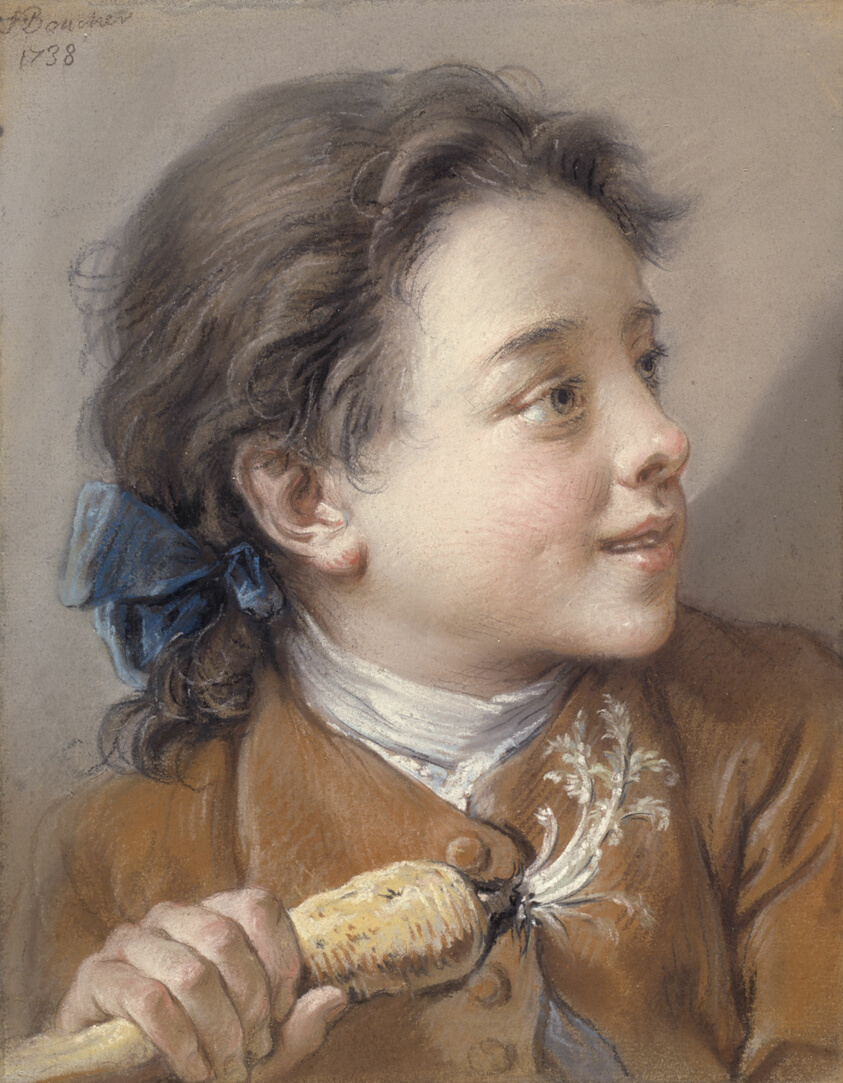
Boy with a Carrot
François BoucherLinkedCulture matchlcp-5df9b5ab1c88
- Date
- 1738
- Medium
- Pastel on buff laid paper
- Culture
- France
- Department
- Prints and Drawings
- Institution
- Art Institute of Chicago
- Object ID
- 35692
François Boucher, whose art epitomized the light-hearted sensuality of the Rococo style, was the most famous painter and decorator during the reign of Louis XV (r. 1715–74), and was championed by Madame de Pompadour, the king’s powerful mistress. Boucher seldom ventured from major paintings and decorative ensembles to do finished, independent works on paper. Nor did he pursue portraiture, apart from his depictions of royal patrons and members of his family. This engaging and fresh portrait of a boy, perhaps a studio apprentice, may well be one of Boucher’s first, and finest, forays into pastel drawing. With this adaptable and newly fashioned medium, Rococo artists were able to imbue their images with a spirited directness and sense of life. Here Boucher captured the dimple-cheeked lad just as he seems to turn, lips parted as if to speak. The youth’s attentive gaze, tousled hair, and delicately elegant city clothes herald the artist’s suave later manner as court painter. The same young model, again holding a carrot, appears in at least two paintings of pastoral subjects by Boucher.
The authoritative record is held by Art Institute of Chicago. LinkedCulture surfaces this object and its connections; it does not alter institutional metadata.
Get printable QR codesHide QR codes
Open QR codes for this object page and the museum record. They stay collapsed until needed.
Provenance & credit
As published by the source institution. Coverage varies — not every institution's open-data feed includes ownership history.
- Credit line
- Helen Regenstein Collection
- Provenance
- Antoine Joseph Dezallier d'Argenville; sold, Paris, 1766, Dezallier d'Argenville sale, lot 72. Randon de Boisset (died 1776); sold, Paris, Feb. 27, 1777, de Boisset sale, lot 201. Bruun-Neergard, Denmark; sold, Aug. 30, 1814, Bruun-Neergard sale, lot 45. Private collection, Cher-et-Loire [according to M. Adler]. Sold, Palais Galleria, Paris, Dec. 7, 1970, lot 1. Sold by Charles E. Slatkin Gallery, New York, to the Art Institute of Chicago, 1971.
Linked open data
Authority identifiers that link this record into the wider web of cultural data — stable references you can follow to the source.
- Object type
- AAT300033973
Related across collections
Semantically similar works from Art Institute of Chicago and other institutions.