Art Institute of Chicago
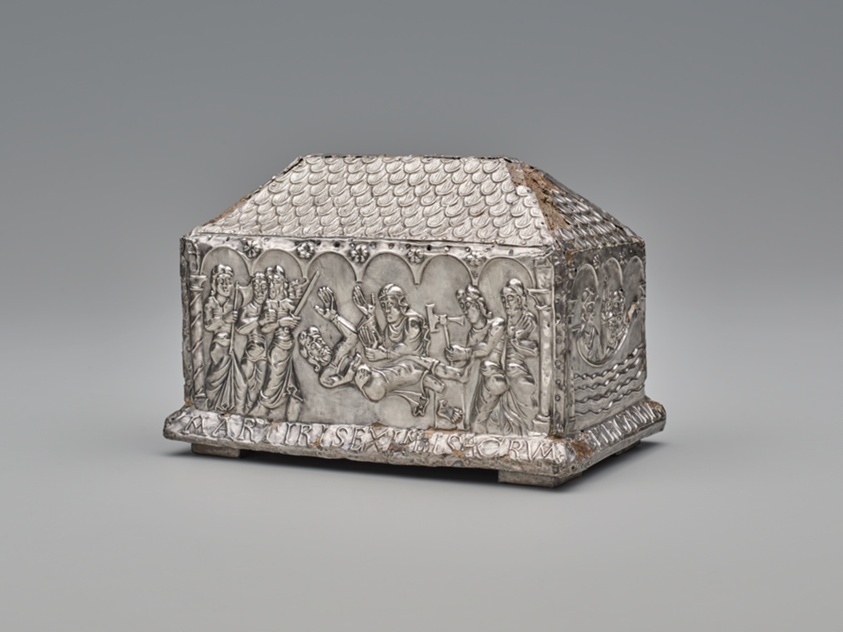
Reliquary Casket of Saints Adrian and Natalia
León, SpainLinkedCulture matchlcp-43d5c6aed215
- Date
- 1100–50
- Medium
- Silver and oak core
- Culture
- Spain
- Department
- Applied Arts of Europe
- Institution
- Art Institute of Chicago
- Object ID
- 46230
From the Art Institute of Chicago record
This rare casket was made to contain the sacred relics of Saint Adrian. It was fashioned like a miniature tomb, complete with a tiled roof and Romanesque columns. Adrian was revered as the patron saint of soldiers and a protector against the plague. A Roman officer in charge of the persecution of Christians, Adrian so admired the virtues of those whom he oppressed that he converted to their faith. After declaring himself a Christian, Adrian was arrested and brutally martyred in the early fourth century. Unflinchingly illustrated on the sides of this reliquary (and reinforced by the inscription) is the story of Adrian’s trial, his dismemberment, and the transport of his remains to a city near Constantinople by his devoted wife, Saint Natalia. The casket’s design was hammered out from the reverse on thin sheets of silver, a technique called repoussé. The figures were reduced to simple, monumental forms composed of convex bulges, reflecting the style of Romanesque relief sculpture and manuscript illumination in northern Spain.
The authoritative record is held by Art Institute of Chicago. LinkedCulture surfaces this object and its connections; it does not alter institutional metadata.
Get printable QR codesHide QR codes
Open QR codes for this object page and the museum record. They stay collapsed until needed.
Provenance & credit
As published by the source institution. Coverage varies — not every institution's open-data feed includes ownership history.
- Credit line
- Kate S. Buckingham Endowment
- Provenance
- Julius Böhler, Munich, by 1914 [see Gudiol 1914–15]. Harry Fuld (d. 1932), Frankfurt, by 1918 [see Swarzenski 1918]; by descent to his widow, Lucie Mayer-Fuld (d. 1966), Frankfurt, Berlin, and New York, 1932–42 [according to incoming shipping receipt in curatorial file]; on loan to museum starting October 17, 1942 [according to incoming receipt in Registrar's file]; sold, through Raphael Stora, to the Art Institute, 1942 [according to incoming shipping receipt, mentioned above].
Linked open data
Authority identifiers that link this record into the wider web of cultural data — stable references you can follow to the source.
- Object type
- AAT300411548
Related across collections
Semantically similar works from Art Institute of Chicago and other institutions.