Art Institute of Chicago
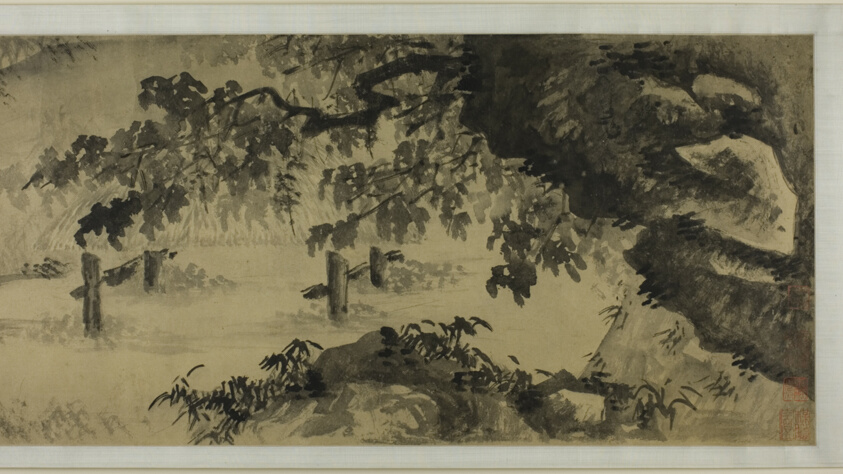
Song of a Fisherman
Wang Wen (1497-1576)LinkedCulture matchlcp-af0266ef5a43
- Date
- Ming dynasty (1368–1644)
- Medium
- Handscroll; ink on paper
- Culture
- China
- Department
- Arts of Asia
- Institution
- Art Institute of Chicago
- Object ID
- 75574
From the Art Institute of Chicago record
Wang Wen exemplified the life of the scholar-official in Ming dynasty China. He retired from government service to his lakeside retreat and pursued painting, calligraphy, and poetry. For this painting, Wang Wen wrote a poem (also entitled “Song of a Fisherman”), which includes several allusions to moral integrity. This poem displays the artist’s distinctively fluid, cursive “draft script” (cao shu). Its first section reads as follows: Most men of the world fish with crooked hooks: I alone trust in hooks, but never in fancy baits. After rain, I carry my long pole to the terrace edge and dangle if from among pines and clouds above the ripples of Qi. (translated by Irving Yucheng Lo) Qi refers to a river in north-central China. This river is cited in several verses of the Shijing (Book of Odes) – a compilation of more than three hundred poems datable between about 1000 and 600 B.C that extol men of principle. Government officials often alluded to these poems to convey Confucian teachings.
The authoritative record is held by Art Institute of Chicago. LinkedCulture surfaces this object and its connections; it does not alter institutional metadata.
Get printable QR codesHide QR codes
Open QR codes for this object page and the museum record. They stay collapsed until needed.
Provenance & credit
As published by the source institution. Coverage varies — not every institution's open-data feed includes ownership history.
- Credit line
- The Orientals Sundry Fund
- Provenance
- Ching Tsai Loo (C.T. Loo, 1880‒1957), Paris and New York; sold to the Art Institute of Chicago, Oct. 10, 1951.
Linked open data
Authority identifiers that link this record into the wider web of cultural data — stable references you can follow to the source.
- Object type
- AAT300033618
Part of a LinkedCulture topic
 Chinese landscape paintings
These are predominantly Chinese paintings from the Ming, Qing, Yuan, and Song dynasties that depict natural landscape scenes including mountains, rivers, forests, and human settlements using traditional media such as ink
180 objects from 5 institutions
Related across collections
Semantically similar works from Art Institute of Chicago and other institutions.