Cleveland Museum of Art
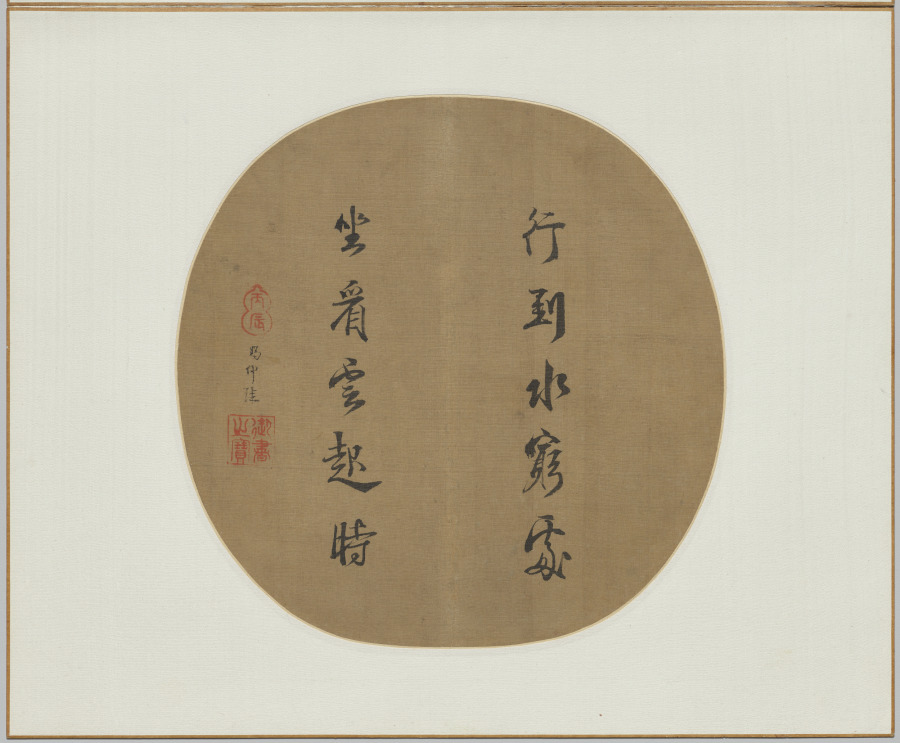
Poem by Wang Wei in the Cursive Script Style
Song LizongLinkedCulture matchlcp-7e4a45090e7b
- Date
- 1256
- Medium
- Album leaf; ink on silk
- Culture
- China, Southern Song dynasty (1127-1279)
- Department
- Chinese Art
- Institution
- Cleveland Museum of Art
- Object ID
- 136951
From the Cleveland Museum of Art record
Poem and painting, once mounted together as one fan, exemplify the collaboration between imperial patron and court painter. Emperor Lizong’s calligraphy cites a verse from Wang Wei’s (701–761) poem, Walking to where the water ends, I sit and watch when clouds arise . Ma Lin’s response is this painting. At the water’s edge, a scholar reclines by a large rock. The view leads across the empty middle ground to a distant mountain. With sparse ink and subtly graded washes, Ma Lin visualizes the poetic verse. The painting suggests the impact of Chan aesthetics through interaction between the palace, literati-officials, and monasteries around Hangzhou. The leaf facing Emperor Lizong’s calligraphy has an inscription by Zhang Daqian (1899–1983). Emperor Lizong had little interest in governmental affairs, but he was perhaps the finest calligrapher among the Song emperors.
The authoritative record is held by Cleveland Museum of Art. LinkedCulture surfaces this object and its connections; it does not alter institutional metadata.
Get printable QR codesHide QR codes
Open QR codes for this object page and the museum record. They stay collapsed until needed.
Provenance & credit
As published by the source institution. Coverage varies — not every institution's open-data feed includes ownership history.
- Credit line
- John L. Severance Fund
- Provenance
- ?–1961: (Nagatani, Inc., Chicago, IL, sold the Cleveland Museum of Art) | 1961–: The Cleveland Museum of Art, Cleveland, OH
Related across collections
Semantically similar works from Cleveland Museum of Art and other institutions.