Art Institute of Chicago
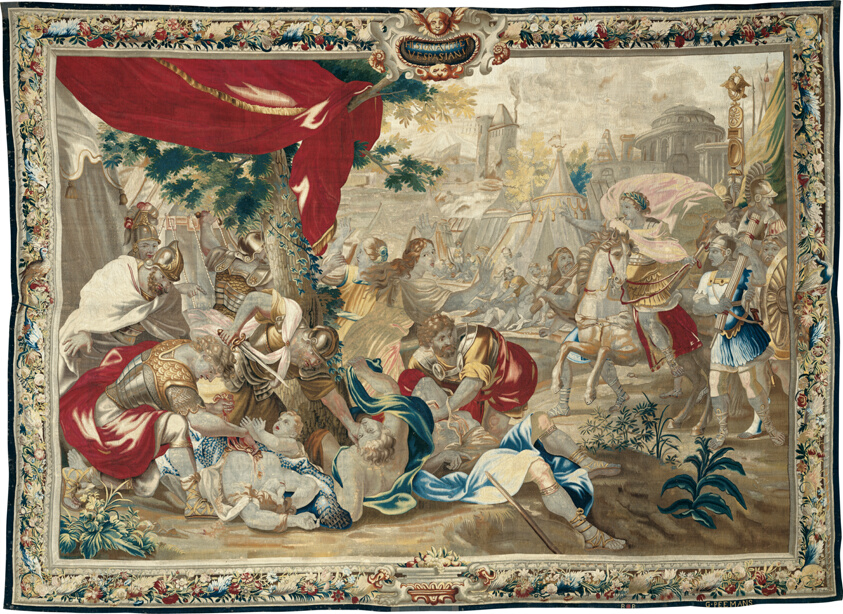
The Massacre at Jerusalem from The Story of Titus and Vespasian
After a design by Charles Poerson (1609–1667)
- Date
- 1650/75
- Medium
- Wool and silk; slit, dovetailed, and double interlocking tapestry weave Warp: Count: 9 warps per cm; wool: S-ply of four Z-spun elements; diameters: 0.7–0.8 mm Weft: Count: varies from 20 to 38 wefts per cm; wool: S-ply of two Z-spun elements; diameters: 0.5–1.0 mm; silk: pairs and three yarns of S-ply of two Z-twisted elements; diameters: 0.6–1.0 mm; wool and silk: paired yarns of S-ply of two Z-spun wool elements and S-ply of two Z-twisted silk elements; diameters: 0.8–1.0 mm
- Culture
- Brussels
- Department
- Textiles
- Institution
- Art Institute of Chicago
This tapestry belongs to the eight-piece Story of Titus and Vespasian suite designed by Charles Poerson, who practiced the French academic-decorative manner that supplanted the dramatic and monumental Flemish High Baroque. Poerson clearly based the series on book two of Tacitus’s The Jewish War (c. A.D. 75–79). Both Vespasian and his son Titus led the Roman troops during the First Jewish-Roman War (A.D. 66–73), a major rebellion by the Jews of Judaea against the Roman Empire. This tapestry depicts the massacre that took place at Jerusalem six months after the initial siege. The Arabian and Syrian soldiers who were part of Titus’s army slaughtered the Jews who were attempting to flee, cutting open their victims’ bellies to get the gold coins some of them had swallowed before surrendering to the Romans. Titus can by seen on horseback, in the background on the right, rushing to stop the carnage.
The authoritative record is held by Art Institute of Chicago. LinkedCulture surfaces this object and its connections; it does not alter institutional metadata.
Linked open data
Authority identifiers that link this record into the wider web of cultural data — stable references you can follow to the source.
- Object type
- AAT300014063
Related across collections
Semantically similar works from Art Institute of Chicago and other institutions.

The Destruction of Jerusalem
Getty Museum

A Jewish Woman Devouring Her Child during the Siege of Jerusalem
Getty Museum

The Martyrdom of Saint Sebastian
Getty Museum

The Massacre of the Innocents
Minneapolis Institute of Art

Study for the figure of Astasius
Getty Museum

The Assassination of the Emperor Vitellius
Getty Museum

The Destruction of Pharaoh's Army and Other Scenes within a Cartouche
Getty Museum

The Death of Germanicus
Minneapolis Institute of Art

Border with Athaliah Ordering the Massacre of the King's Children
Getty Museum

Border with Joab Stabbing Abner
Getty Museum

Esther and Ahasuerus
Minneapolis Institute of Art

Initial S: The Massacre of the Innocents
Getty Museum