Art Institute of Chicago
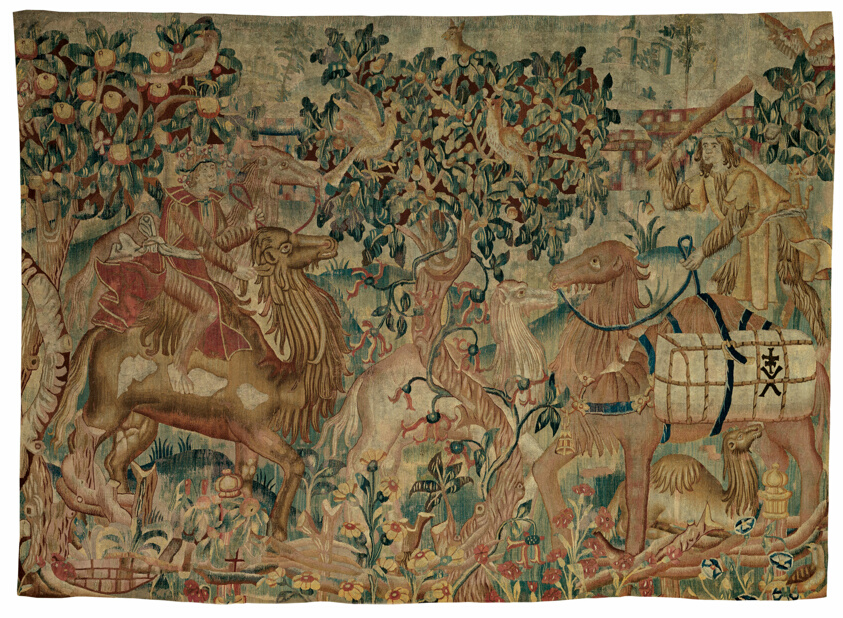
Camel Riders, presumably from a Wild Man series
Franco-FlemishLinkedCulture matchlcp-83dcbfd1d104
- Date
- 1475-1510
- Medium
- Wool, slit tapestry weave Warp: Count: 3–4 warps per cm; wool: S-ply of two Z-spun elements; diameters: 1.0–1.2 mm Weft: Count: varies from 10 to 17 wefts per cm; wool: single S-spun elements; diameters: 0.5–1.2 mm
- Culture
- Flanders
- Department
- Textiles
- Institution
- Art Institute of Chicago
- Object ID
- 86331
From the Art Institute of Chicago record
This tapestry includes two merchants dressed as wild men in tunics, riding camel-like animals. The identification of the men as merchants is supported by the merchant’s mark on a bale at the left of the scene. Wild men are mythical creatures believed to have inhabited the woods and mountains of Europe. Depictions of wild men lend themselves to two opposing narratives: uncivilized beasts existing outside society, and peaceful creatures living harmoniously with nature. Contemporary accounts—which reveal a fascination with imaginary creatures—record men and women dressed in wild costume for carnivals, courtly events, and other festivities. Despite the aggressive gestures and hostile manners of the men, this scene may represent a mock joust in which merchant rivalry was harmlessly expressed during an urban feast.
The authoritative record is held by Art Institute of Chicago. LinkedCulture surfaces this object and its connections; it does not alter institutional metadata.
Get printable QR codesHide QR codes
Open QR codes for this object page and the museum record. They stay collapsed until needed.
Provenance & credit
As published by the source institution. Coverage varies — not every institution's open-data feed includes ownership history.
- Credit line
- Robert Allerton Fund
- Provenance
- Demotte, Inc., New York, by 1927 [incoming receipt, R3534, Nov. 30, 1927; copy in curatorial object file]; sold to the Art Institute, 1929
Linked open data
Authority identifiers that link this record into the wider web of cultural data — stable references you can follow to the source.
- Object type
- AAT300014063
Related across collections
Semantically similar works from Art Institute of Chicago and other institutions.