Cleveland Museum of Art
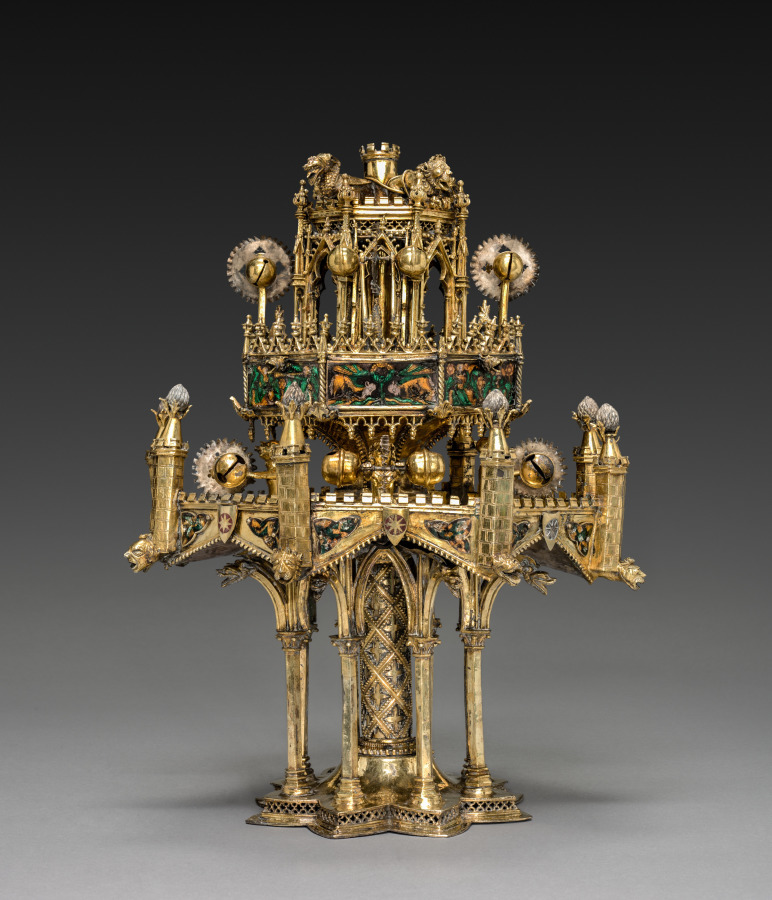
Table Fountain
- Date
- c. 1320–40
- Medium
- gilt-silver and translucent enamels
- Culture
- France, Paris
- Department
- Medieval Art
- Institution
- Cleveland Museum of Art
- Object ID
- 106841
From the Cleveland Museum of Art record
Conceptually and stylistically, this object is beyond all else a piece of Gothic architecture in miniature with vaults, pinnacles, columns, and traceried arches. Though the artist who created it is unknown, he was unquestionably inspired by the great Gothic buildings of his time. The table fountain is a three-tiered assembly combining cast elements with bent sheets of gilt-silver. To these have been attached a series of enamel plaques representing grotesque figures, some of which play musical instruments. Water wheels and bells were added to capture motion and sound. The rich detail, precious materials, and involved ornamentation of this deluxe object suggest it would have been expensive to produce and highly treasured by its original owner, someone of high status, and would have been deployed as an object of spectacle. This is the most complete example of its type known to survive from the Middle Ages. Medieval inventories reveal that small fountains like this, often taking various forms, and generally made from precious metals, once existed in large numbers, thus making the Cleveland table fountain an extremely rare object. This fountain with its minute architectural details and finely made enamel plaques displayed the wealth and refinement of the owner as it entertained his guests. Imagine hearing the ringing of the tiny bells when this fountain was in use.
The authoritative record is held by Cleveland Museum of Art. LinkedCulture surfaces this object and its connections; it does not alter institutional metadata.
Get printable QR codesHide QR codes
Open QR codes for this object page and the museum record. They stay collapsed until needed.
Provenance & credit
As published by the source institution. Coverage varies — not every institution's open-data feed includes ownership history.
- Credit line
- Gift of J. H. Wade
- Provenance
- ?-1924: (M. & R. Stora, Paris, France, sold to the Cleveland Museum of Art) | 1924-: The Cleveland Museum of Art, Cleveland, OH
Related across collections
Semantically similar works from Cleveland Museum of Art and other institutions.