Cleveland Museum of Art
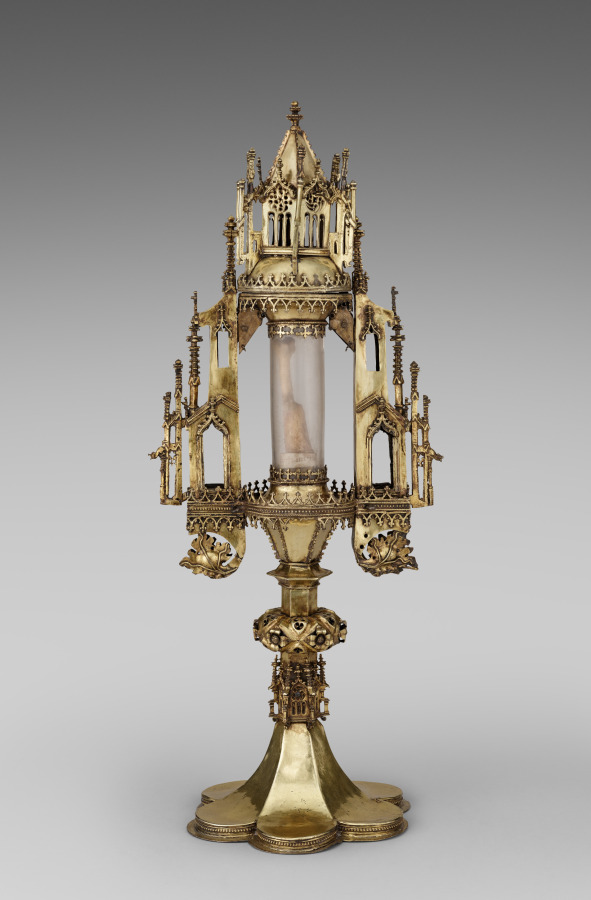
Monstrance with a Relic of Saint Sebastian
- Date
- 1484
- Medium
- gilded silver, rock crystal, bone, parchment
- Culture
- Germany, Lower Saxony, Brunswick, Gothic period, 15th century
- Department
- Medieval Art
- Institution
- Cleveland Museum of Art
- Object ID
- 112971
From the Cleveland Museum of Art record
This Late Gothic monstrance (from the Latin monstrare, "to show") is mentioned in the earliest inventory of Saint Blaise as "a large new monstrance containing relics of Saint Sebastian the martyr." Judging from surviving receipts, the reliquary was made by Werner Korff, a local goldsmith, who received payments for silver and gilding at the end of 1484. The reliquary was first displayed on the altar of the church of Saint Blaise in a solemn penitential mass on June 4, 1484, in an effort to ward off the plague. A recent examination revealed that the relic is a human metatarsal bone (one of five long bones of the human foot) and that its owner seemed to have suffered from periostitis, a medical condition that affects the connective tissue surrounding the bone. In the Middle Ages, people suffering from diseases might make a journey, or pilgrimage, to venerate relics such as this one. The faithful believed that the remains of saints and holy people like Saint Sebastian could help those seeking aid such as relief from the plague.
The authoritative record is held by Cleveland Museum of Art. LinkedCulture surfaces this object and its connections; it does not alter institutional metadata.
Get printable QR codesHide QR codes
Open QR codes for this object page and the museum record. They stay collapsed until needed.
Provenance & credit
As published by the source institution. Coverage varies — not every institution's open-data feed includes ownership history.
- Credit line
- Gift of Julius F. Goldschmidt, Z. M. Hackenbroch, and J. Rosenbaum in memory of the Exhibition of the Guelph Treasure held in the Cleveland Museum of Art from 10 January to 1 February 1931
- Provenance
- Treasury, Cathedral of St. Blaise, Brunswick; House of Brunswick-Lüneburg; Julius F. Goldschmidt, New York.
Related across collections
Semantically similar works from Cleveland Museum of Art and other institutions.