Cleveland Museum of Art
Satyress
Giovanni Maria MoscaLinkedCulture matchlcp-36d886e600d8
- Date
- c. 1525–1528
- Medium
- bronze
- Culture
- Italy, 16th century
- Department
- European Painting and Sculpture
- Institution
- Cleveland Museum of Art
- Object ID
- 125337
From the Cleveland Museum of Art record
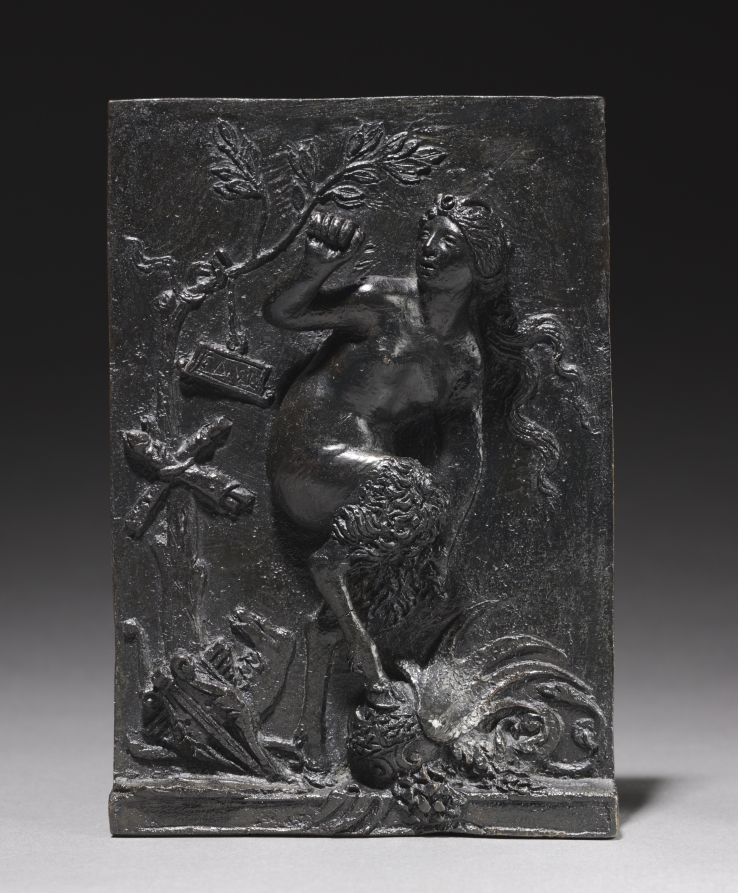
In antiquity, satyrs were lustful woodland deities who delighted in wine and revelry. Renaissance artists adopted them as symbols of vice and carnal love; the female satyr, or satyress, on this bronze plaquette, recently reattributed from Riccio to Mosca, was probably derived from a copper engraving of a Roman sarcophagus by Marcantonio Raimondi (c. 1470/82-1527/34). Both the sarcophagus and subsequent engraving depicted a bacchanalia, or scene of orgiastic carousal; the peculiar objects surrounding the satyress have been added by the artist, possibly in an effort to remove the figure from her lewd original composition and give a more refined meaning. The satyress rests her right hoof upon a plumed helmet. A coiled shape, possibly a snake, winds out of the helmet. To her left, a laurel tree stands with only half of its branches in bloom. Two severed animal legs are tied around its trunk and an illegible plaque hangs from one of its branches. A lyre, a pan pipe, an animal jawbone and a bow are gathered at the base of the tree. The highly allegorical nature of the work uses obscure symbols, rather than a distinct narrative, to convey meaning and could possibly be read as an allegory of physical pleasure overcoming virtue.
The authoritative record is held by Cleveland Museum of Art. LinkedCulture surfaces this object and its connections; it does not alter institutional metadata.
Get printable QR codesHide QR codes
Open QR codes for this object page and the museum record. They stay collapsed until needed.
Provenance & credit
As published by the source institution. Coverage varies — not every institution's open-data feed includes ownership history.
- Credit line
- Gift of Mr. and Mrs. Severance A. Millikin
- Provenance
- Dona delle Rose (Venice, Italy), sold to Ernö Wittman, ca. 1932 | Ernö Wittmann (Budapest, Hungary), died 1963, sold through R. Stora & Co. (New York, New York) to the Cleveland Museum of Art, 1947.
Related across collections
Semantically similar works from Cleveland Museum of Art and other institutions.