Cleveland Museum of Art
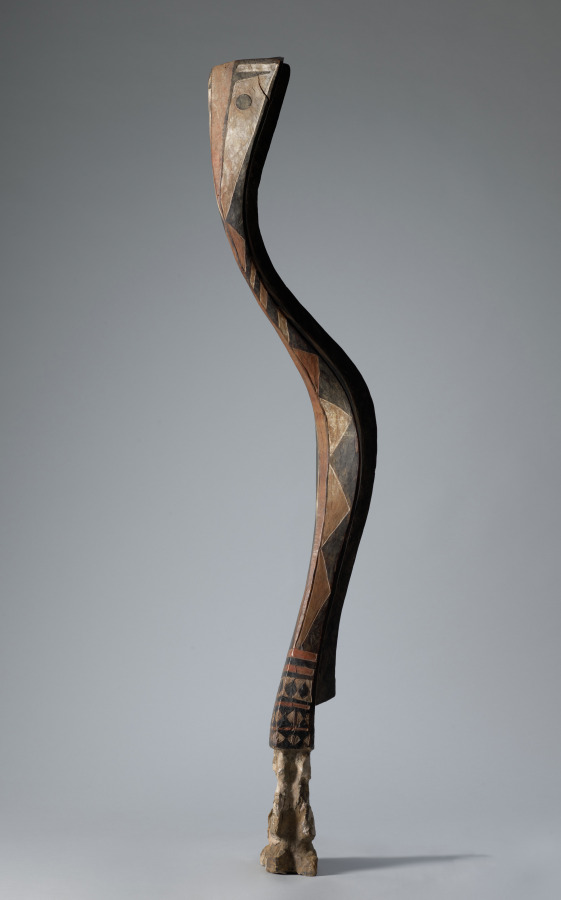
Serpent Headdress
- Date
- late 1800s–early 1900s
- Medium
- Wood (Nauclea pobeguinii) and paint
- Culture
- Africa, West Africa, Guinea, possibly Baga-style maker
- Department
- African Art
- Institution
- Cleveland Museum of Art
- Object ID
- 136459
From the Cleveland Museum of Art record
Nearly five feet tall, this serpent headdress towered above crowds when danced. Its two faces seemed to look in all directions. Secured by a conical framework of palm branches on a costumed man’s head, it appeared at key points in initiation rites for both boys and girls. This multi-colored snake may be the serpent-spirit Ninkinanka. It can be likened to the rainbow, whose changing colors evoke how boys transform into men during initiation. A staged circa 1954 photograph depicts the serpent headdress now at the CMA. Serpent masquerades stopped in the mid-1950s when most Nalu and Baga people converted to Islam. In the context of boys' initiations, the serpent headdress was sometimes identified as the rainbow, which the Baga and their neighbors associate with beginnings and endings, life and death, and the continuation of lineages.
The authoritative record is held by Cleveland Museum of Art. LinkedCulture surfaces this object and its connections; it does not alter institutional metadata.
Get printable QR codesHide QR codes
Open QR codes for this object page and the museum record. They stay collapsed until needed.
Provenance & credit
As published by the source institution. Coverage varies — not every institution's open-data feed includes ownership history.
- Credit line
- The Norweb Collection
- Provenance
- ca.1954–1960: Jacqueline (and Maurice?) Nicaud by purchase. Possibly village of Kanfrande [Kanfarandé], District of Boke, French Guinea. | by 1960: Mathias Komor, New York, NY | 1960: Emery May Norweb (aka Mrs. R. Henry Norweb) by purchase | 1960–: The Cleveland Museum of Art by gift
Related across collections
Semantically similar works from Cleveland Museum of Art and other institutions.