Cleveland Museum of Art
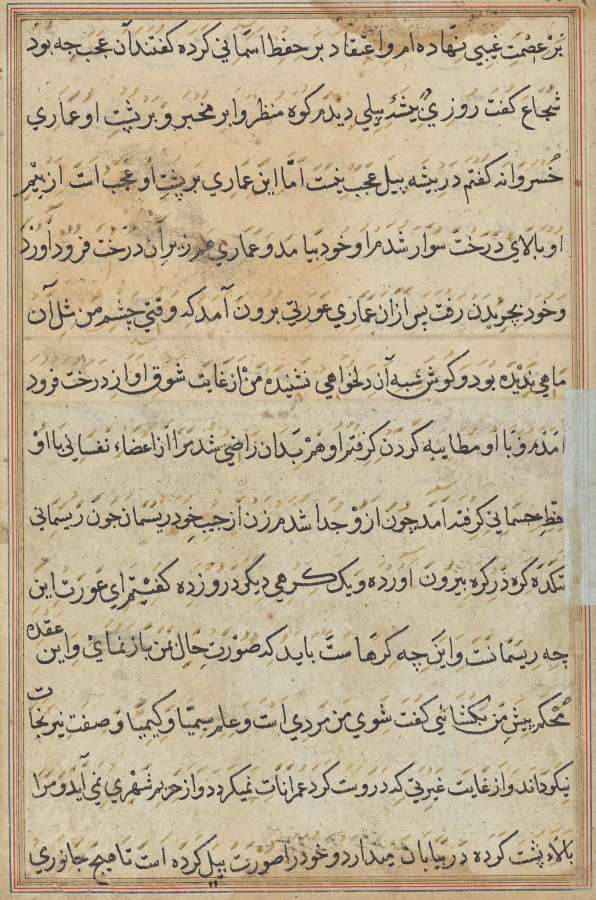
The mendicant’s wife deceives him with a soldier, from a Tuti-nama (Tales of a Parrot): Fourth Night
- Date
- c. 1560
- Medium
- gum tempera, ink, and gold on paper
- Culture
- Mughal India, court of Akbar (reigned 1556–1605)
- Department
- Indian and Southeast Asian Art
- Institution
- Cleveland Museum of Art
- Object ID
- 137697
From the Cleveland Museum of Art record
According to this story, written in Persian, a skilled yogi in India reached such a high level of practice that he was able to perform acts of transformation. Anxious to prevent his wife from committing adultery, he transformed himself into an elephant and carried her hidden in a howdah on his back and stayed only in the deep forest, away from men. One day, when the elephant was out foraging for food, a lone soldier came upon the wife, and they made love. The moral of the story is that no matter how extreme the lengths to which one might go to prevent adultery, if someone is inclined to do so, it will happen. Discoloration around the elephant’s face and legs indicate that his body has been repositioned.
The authoritative record is held by Cleveland Museum of Art. LinkedCulture surfaces this object and its connections; it does not alter institutional metadata.
Get printable QR codesHide QR codes
Open QR codes for this object page and the museum record. They stay collapsed until needed.
Provenance & credit
As published by the source institution. Coverage varies — not every institution's open-data feed includes ownership history.
- Credit line
- Gift of Mrs. A. Dean Perry
- Provenance
- ?–1959: Estate of Breckinridge Long [1881–1958], Bowie, MD | 1959–1962?: (Harry Burke Antiques, Philadelphia, PA) | 1959?–1962: (Bernard Brown Agency, Milwaukee, WI, sold to the Cleveland Museum of Art. Purchased with funds from Mrs. A. Dean [Helen Wade Greene] Perry) | 1962–: The Cleveland Museum of Art, Cleveland, OH
Related across collections
Semantically similar works from Cleveland Museum of Art and other institutions.