Cleveland Museum of Art
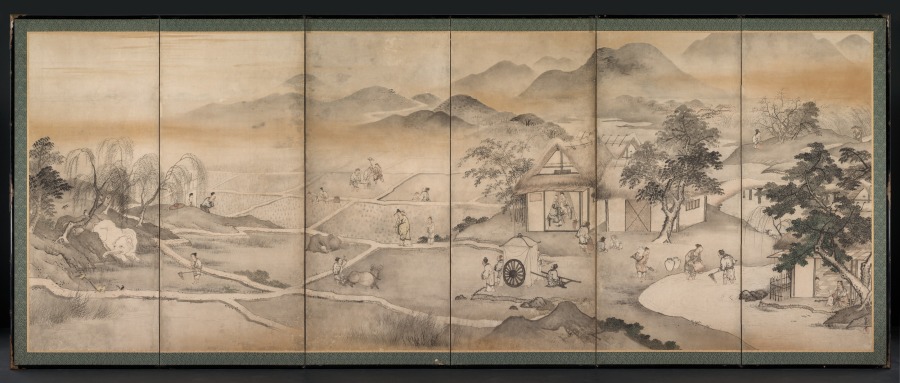
Emperor Yao Visiting Yu Chonghua
Kusumi MorikageLinkedCulture matchlcp-cea7c2aa9f49
- Date
- mid- to late 1600s
- Medium
- One of a pair of six-panel folding screens, ink, slight color, and gold on paper
- Culture
- Japan, Edo period (1615–1868)
- Department
- Japanese Art
- Institution
- Cleveland Museum of Art
- Object ID
- 143650
From the Cleveland Museum of Art record
One of a pair, this screen shows a section of the narrative of how the Chinese Emperor Yao (about 2356–2255 BC) selected his successor, Yu Chonghua (about 2294– 2184 BC), who would become Emperor Shun. The artist who painted this screen, Kusumi Morikage, trained with Kano Tan’yō (1602–1647), painter-in-residence to Japan’s shogun, the country’s ruler, and was one of his four top students. Despite the conservative subject matter, Morikage’s distinctive sensibility shines through in his playful treatment of the gray and white elephants in the far left panel of the composition. According to legend, Chonghua was so virtuous that in the spring, elephants bounded down from the mountains to help him till the soil with their tusks. The emperor's two-wheeled carriage sits in front of a thatched-roof farmhouse.
The authoritative record is held by Cleveland Museum of Art. LinkedCulture surfaces this object and its connections; it does not alter institutional metadata.
Get printable QR codesHide QR codes
Open QR codes for this object page and the museum record. They stay collapsed until needed.
Provenance & credit
As published by the source institution. Coverage varies — not every institution's open-data feed includes ownership history.
- Credit line
- John L. Severance Fund
- Provenance
- ?-1968: (Harry C. Nail, Jr. [1909-1990] sold to the Cleveland Museum of Art) | 1968: The Cleveland Museum of Art, Cleveland, OH
Related across collections
Semantically similar works from Cleveland Museum of Art and other institutions.