Cleveland Museum of Art
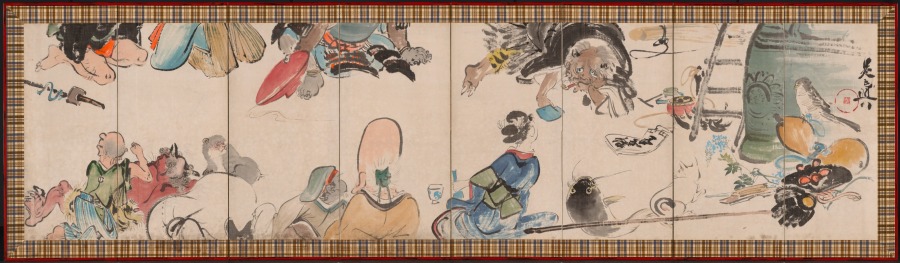
Gathering of Otsu-e Subjects
Shibata ZeshinLinkedCulture matchlcp-88ba2d05046c
- Date
- late 1800s
- Medium
- Eight-panel folding screen; ink and color on hemp
- Culture
- Japan, Meiji period (1868–1912)
- Department
- Japanese Art
- Institution
- Cleveland Museum of Art
- Object ID
- 151064
From the Cleveland Museum of Art record
This lively scene captures a gathering of stock figures from Otsu-e, or "Otsu paintings." Otsu-e were folk paintings made as souvenirs for travelers passing through the station of Otsu along the Tokaido, the route stretching from Edo (modern-day Tokyo) to Kyoto. Parodies of standard ukiyo-e compositions featuring Otsu-e subjects were popular in woodblock prints of the 19th century. Shibata Zeshin, an artist whose career spanned the transition from the Edo period (1615–1868) to the Meiji period (1868–1912), was fond of depicting urban culture and the pastimes of commoners, aware that they were slipping away in the face of Japan’s modernization. This composition would have appealed to the witty sensibilities of city denizens. Shibata Zeshin was not only famous in the realm of painting but also in the world of lacquer design.
The authoritative record is held by Cleveland Museum of Art. LinkedCulture surfaces this object and its connections; it does not alter institutional metadata.
Get printable QR codesHide QR codes
Open QR codes for this object page and the museum record. They stay collapsed until needed.
Provenance & credit
As published by the source institution. Coverage varies — not every institution's open-data feed includes ownership history.
- Credit line
- John L. Severance Fund
- Provenance
- ?–1982: (Marion Hammer, New York, NY, sold to the Cleveland Museum of Art) | 1982–: The Cleveland Museum of Art, Cleveland, OH
Related across collections
Semantically similar works from Cleveland Museum of Art and other institutions.