Cleveland Museum of Art
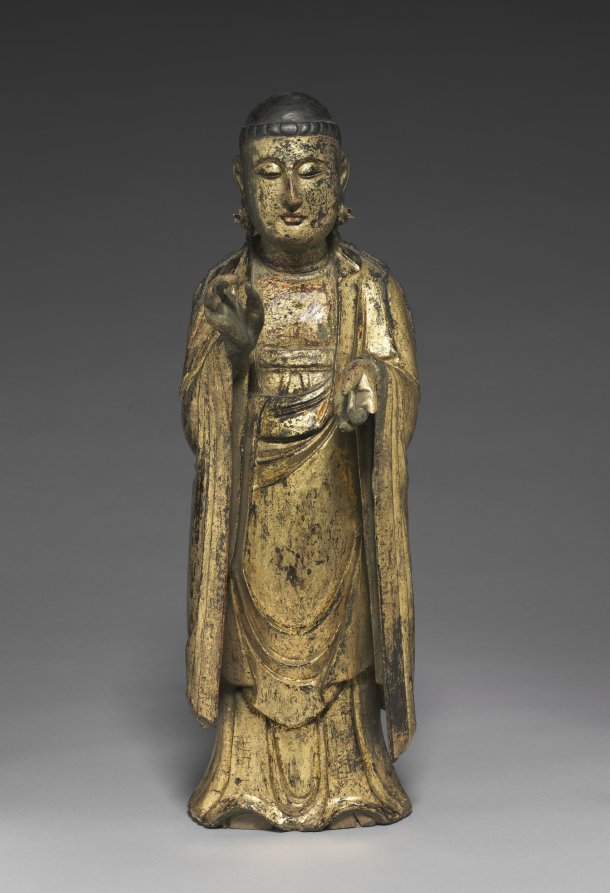
Standing Bodhisattva
- Date
- 1500s
- Medium
- wood with lacquer and gold, and metal earrings
- Culture
- Korea, Joseon dynasty (1392–1910)
- Department
- Korean Art
- Institution
- Cleveland Museum of Art
- Object ID
- 159737
From the Cleveland Museum of Art record
This work demonstrates the enduring presence of Buddhism and its religious practice during the Joseon dynasty (1392–1910) even after Neo-Confucianism, a revised form of Confucianism that emphasized self-cultivation as a path to the formation of a harmonious society and state, became the state religion. Because of its missing crown, it is hard to identify what Buddhist deity this statue represents. But there is no doubt it still can be attributed to a bodhisattva (meaning “enlightened being”) for its iconographic attributes: elaborate jewelry and a lock of long hair. This Buddhist statue is missing its crown, which makes it hard to identify what deity it represents.
The authoritative record is held by Cleveland Museum of Art. LinkedCulture surfaces this object and its connections; it does not alter institutional metadata.
Get printable QR codesHide QR codes
Open QR codes for this object page and the museum record. They stay collapsed until needed.
Provenance & credit
As published by the source institution. Coverage varies — not every institution's open-data feed includes ownership history.
- Credit line
- Leonard C. Hanna Jr. Fund
- Provenance
- ?–1997: The Honorable Joseph P. Carroll and Roberta Carroll, MD, New York, NY | 1997: (Joseph P. Carroll, Ltd., New York, NY, sold to the Cleveland Museum of Art) | 1997–: The Cleveland Museum of Art, Cleveland, OH
Related across collections
Semantically similar works from Cleveland Museum of Art and other institutions.