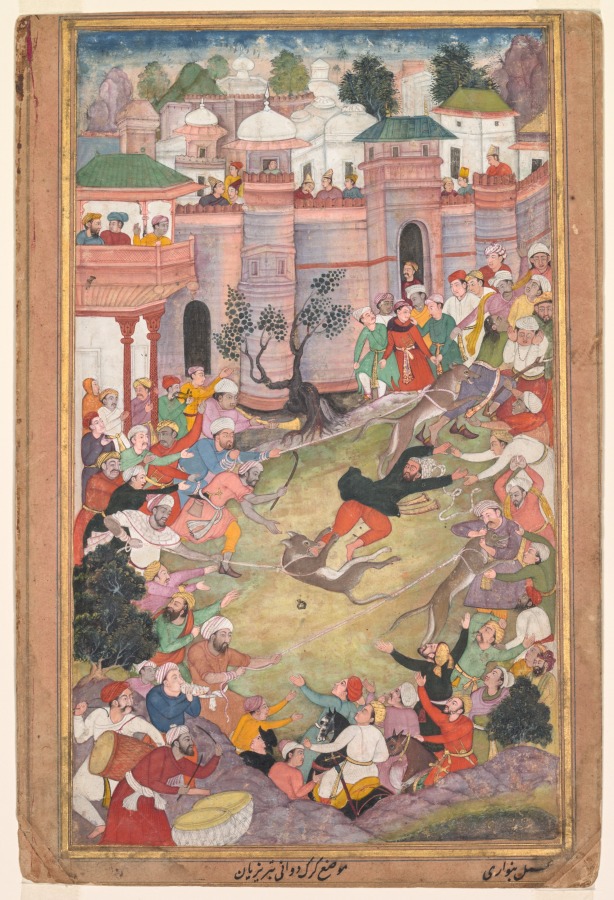
The game of wolf-running in Tabriz, from an Akbar-nama (Book of Akbar)

Cleveland Museum of Art

The game of wolf-running in Tabriz, from an Akbar-nama (Book of Akbar)

Banavari 1

Date
c. 1595–1600
Medium
Gum tempera, ink, and gold on paper
Department
Indian and Southeast Asian Art
Institution
Cleveland Museum of Art

After four years of traveling in exile, fleeing Afghan forces, Humayun reached Tabriz, the glittering capital of the Safavid dynasty in northwestern Iran, here imaginatively rendered by the Indian artist. There the second Mughal emperor enjoyed warm hospitality extended by the shah of Iran, who called for a game of wolf-running for which the city was famous. Artists painting during the time of Akbar, late in his reign when historical subjects dominated, speculated as to how the game was played, based on eyewitness accounts. They gave the figures lively emotive expressions and gestures, and the dense crowding successfully conveys the pandemonium of the scene. During extreme activities, turbans could come unwound and fall off.

The authoritative record is held by Cleveland Museum of Art. LinkedCulture surfaces this object and its connections; it does not alter institutional metadata.

Related across collections

Semantically similar works from Cleveland Museum of Art and other institutions.

Mughal ruler Humayun defeating the Afghans before reconquering India, folio from an Akbar-nama (Book of Akbar) of Abu’l Fazl (Indian, 1551–1602)

Mughal ruler Humayun defeating the Afghans before reconquering India, folio from an Akbar-nama (Book of Akbar) of Abu’l Fazl (Indian, 1551–1602)

Cleveland Museum of Art

Page from a Shah-nama (Book of Kings) of Firdausi (Persian, about 934–1020)

Page from a Shah-nama (Book of Kings) of Firdausi (Persian, about 934–1020)

Cleveland Museum of Art

Rustam meets the challenge of Ashkabus, from a Shah-nama (Book of Kings) of Firdausi (Persian, about 934–1020)

Rustam meets the challenge of Ashkabus, from a Shah-nama (Book of Kings) of Firdausi (Persian, about 934–1020)

Cleveland Museum of Art

Rustam meets the challenge of Ashkabus, from a Shah-nama (Book of Kings) of Firdausi (Persian, about 934–1020)

Rustam meets the challenge of Ashkabus, from a Shah-nama (Book of Kings) of Firdausi (Persian, about 934–1020)

Cleveland Museum of Art

An Ambassador before Humayun

An Ambassador before Humayun

Cleveland Museum of Art

The Young Emperor Akbar Arrests the Insolent Shah Abu’l-Maali, Page from a Manuscript of the Akbarnama

The Young Emperor Akbar Arrests the Insolent Shah Abu’l-Maali, Page from a Manuscript of the Akbarnama

Art Institute of Chicago

Hunting with falcons in a landscape; verso: Calligraphy of Chaghatai Turkish poems in praise of wine, Sultan Muhammad Nur (Persian, c. 1472–1536) and Mirza Muhammad (probably Persian, active c. 1520s)

Hunting with falcons in a landscape; verso: Calligraphy of Chaghatai Turkish poems in praise of wine, Sultan Muhammad Nur (Persian, c. 1472–1536) and Mirza Muhammad (probably Persian, active c. 1520s)

Cleveland Museum of Art

Bahram Gur Arrives at the House of a Merchant, text page (recto), from a Shahnama (Book of Kings) of Firdausi (940–1019 or 1025), known as the Great Mongol Shahnama

Bahram Gur Arrives at the House of a Merchant, text page (recto), from a Shahnama (Book of Kings) of Firdausi (940–1019 or 1025), known as the Great Mongol Shahnama

Cleveland Museum of Art

Bahram Gur Arrives at the House of a Merchant, text page (recto); Bahram Gur Slays a Dragon (verso), from a Shahnama (Book of Kings) of Firdausi (940–1019 or 1025), known as the Great Mongol Shahnama

Bahram Gur Arrives at the House of a Merchant, text page (recto); Bahram Gur Slays a Dragon (verso), from a Shahnama (Book of Kings) of Firdausi (940–1019 or 1025), known as the Great Mongol Shahnama

Cleveland Museum of Art

Story of Haftvad

Story of Haftvad

Minneapolis Institute of Art

Hunting with falcons in a landscape (recto)

Hunting with falcons in a landscape (recto)

Cleveland Museum of Art

Babur receives booty and Humayun’s salute after the victory over Sultan Ibrahim in 1526, from an Akbar-nama (Book of Akbar) of Abu’l Fazl (Indian, 1551–1602)

Babur receives booty and Humayun’s salute after the victory over Sultan Ibrahim in 1526, from an Akbar-nama (Book of Akbar) of Abu’l Fazl (Indian, 1551–1602)

Cleveland Museum of Art