Cleveland Museum of Art
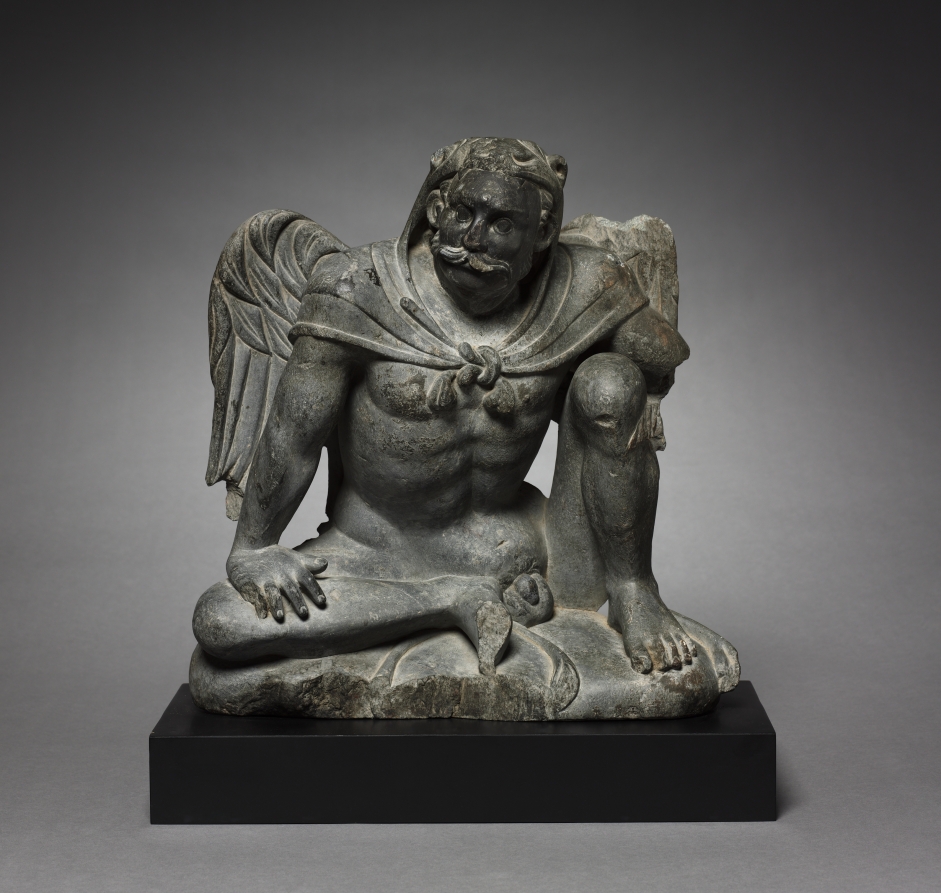
Winged Atlas-Hercules
- Date
- 200s CE
- Medium
- schist
- Culture
- Pakistan, Gandhara, Gandhara period
- Department
- Indian and Southeast Asian Art
- Institution
- Cleveland Museum of Art
- Object ID
- 169251
From the Cleveland Museum of Art record
In Buddhist art of the Gandharan region during the time of heightened contact with the Mediterranean world, the figure of Atlas was adopted, but given wings so as to appear superhuman. This figure has been conflated with the image of Hercules, who wears the skin of the Nemean lion, and relieved Atlas of his duties for a short time. Repeated images of composite Atlas-like figures surrounded the base of the monuments called stupas, which were solid domes, and can be understood as symbols for the sky, which would have appeared as though supported by rows of titanic figures. Other examples of this figure hold a thunderbolt ( vajra ) in one hand, suggesting that he could also allude to Vajrapani, an early protector divinity of the Buddha. Images of Vajrapani can combine attributes of Hercules, Zeus, and Hermes. This figure combines the attributes of Atlas, Hercules, and Vajrapani.
The authoritative record is held by Cleveland Museum of Art. LinkedCulture surfaces this object and its connections; it does not alter institutional metadata.
Get printable QR codesHide QR codes
Open QR codes for this object page and the museum record. They stay collapsed until needed.
Provenance & credit
As published by the source institution. Coverage varies — not every institution's open-data feed includes ownership history.
- Credit line
- Gift of Maxeen and John Flower in honor of Dr. Stanislaw Czuma
- Provenance
- March 25, 1999: (Sotheby's New York, NY, March 25, 1999, lot 135, sold to John Eskenazi) | March 25, 1999–?: (John Eskenazi, London, England, sold to Maxeen Stone Flower) | –2011: Dr. John [1921–2011] and Maxeen Stone Flower [1928–2010], Shaker Heights, OH, bequest to the Cleveland Museum of Art | 2011–: The Cleveland Museum of Art, Cleveland, OH
Related across collections
Semantically similar works from Cleveland Museum of Art and other institutions.