Cleveland Museum of Art
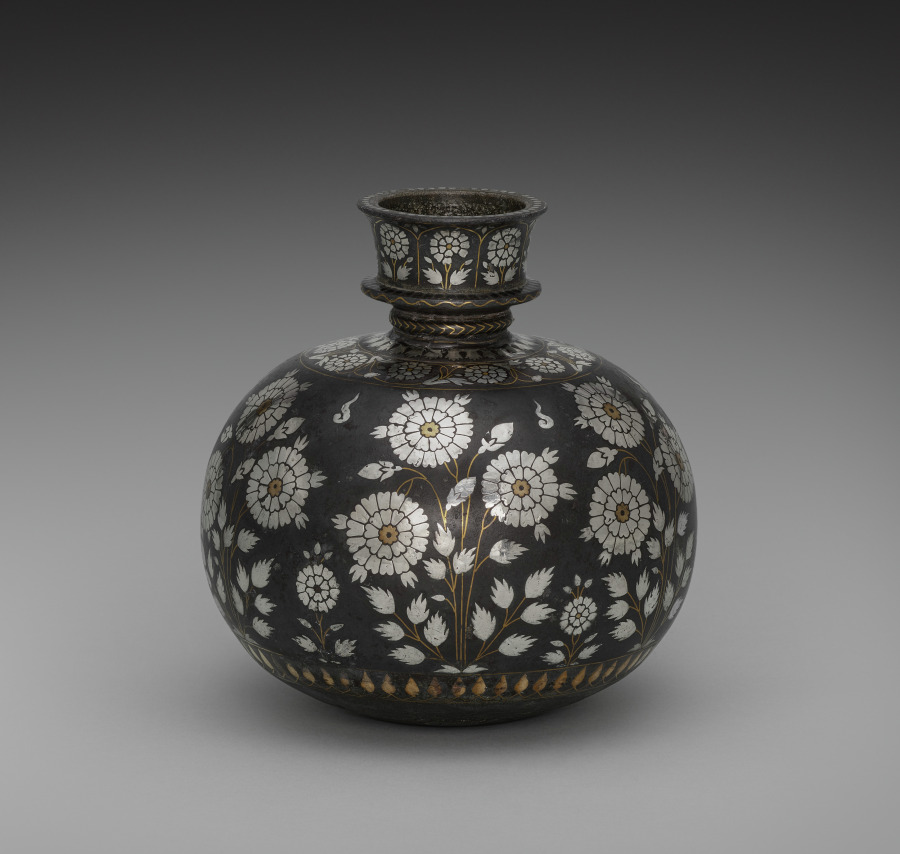
Bidri Hookah Bowl with Roses
- Date
- c. 1650s
- Medium
- Zinc alloy with silver and brass inlay
- Culture
- Southwestern India, Deccan, Karnataka, Bidar
- Department
- Indian and Southeast Asian Art
- Institution
- Cleveland Museum of Art
- Object ID
- 387679
From the Cleveland Museum of Art record
Hookah bowls were used for the enjoyment of tobacco or any other smoked substance during moments of relaxation. They were also aesthetic objects to be admired in elite gatherings of connoisseurs. The flowering rose bushes on this fine early example, made shortly after the introduction of tobacco-smoking in India, would have called to mind celebrated poetical works, such as the Gulistan (Rose Garden) of Sa'di (Persian, 1210–1291 or 1292). Bidri ware is cast from condensed vapors of zinc mined from Sawar in Rajasthan.
The authoritative record is held by Cleveland Museum of Art. LinkedCulture surfaces this object and its connections; it does not alter institutional metadata.
Get printable QR codesHide QR codes
Open QR codes for this object page and the museum record. They stay collapsed until needed.
Provenance & credit
As published by the source institution. Coverage varies — not every institution's open-data feed includes ownership history.
- Credit line
- Severance and Greta Millikin Purchase Fund
- Provenance
- 1968-1999: Dr. Mark Zebrowski [1945-1999], London, UK, by descent to his partner John Robert Alderman | 1999-2020: (John Robert Alderman, London, UK, consigned to Francesca Galloway, Ltd. for sale) | 2020: (Francesca Galloway, Ltd., London, UK, sold to the Cleveland Museum of Art) | 2020-: The Cleveland Museum of Art, Cleveland, OH
Related across collections
Semantically similar works from Cleveland Museum of Art and other institutions.